

Alkali bee
The alkali bee is a small bee with shiny metallic stripes on its black tummy. It digs its nest in salty, muddy ground in the dry west of the United States. Each mother has her own nest, but thousands of them can live close together, like a busy bee town.
How fast is it?
Fun facts
It is a champion at pollinating alfalfa. It presses on the flower so it snaps open.
Farmers make special salty mud fields just so alkali bees can nest there.
It is only about two thirds the size of a honeybee.
Males have white faces.
Bees in the north are bigger than bees in the south.
Most asked questions about Alkali bee
?Why is it called the alkali bee?
Because it digs its nests in salty, alkaline soil.
?Why do farmers like alkali bees?
They are very good at opening and pollinating alfalfa flowers, which helps the farmers get more seeds.
For bug experts
- Scientific name
- Nomia melanderi
- Named by
- Cockerell, 1906
- Group
- Bees and bumblebees
- Family
- Halictidae
- Classification
- Insecta > Hymenoptera > Halictidae
- Lives on
- North America
Where the facts come from
- Alkali bee (Wikipedia, CC BY-SA 4.0): what it looks like, where it lives, what it eats, sizes and fun facts, retold in simple words.
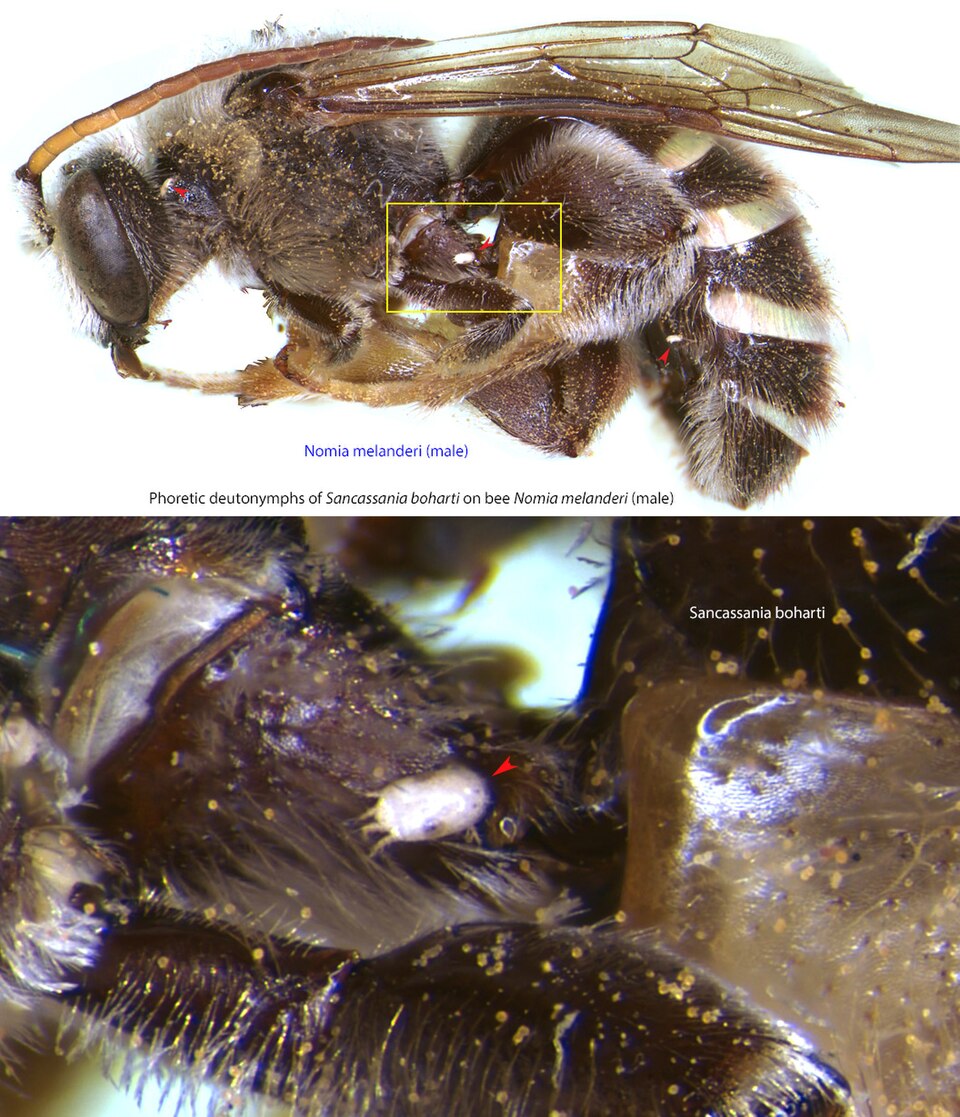
- Picture by Photo or drawing by Pavel Klimov, Bee Mite ID (idtools.org/id/mites/beemites) unless otherwise stated in description on Bee mites website.. Public domain, Wikimedia Commons. The round sticker of this bug is cut from the same picture.
If we got something wrong, sorry, we are bug fans, not a science journal. Tell us at hello@bugwiki.app and we will fix it.
 Western honey bee
 Buff-tailed bumblebee
 Violet carpenter bee
 Giant honey bee
 Wallace's giant bee
 Himalayan giant honey bee
 Arizona bark scorpion
 Sacred scarab
 Giant desert centipede
 Conehead mantis
 Pinacate beetle
 Mexican redknee tarantula