

Black-tailed bumblebee
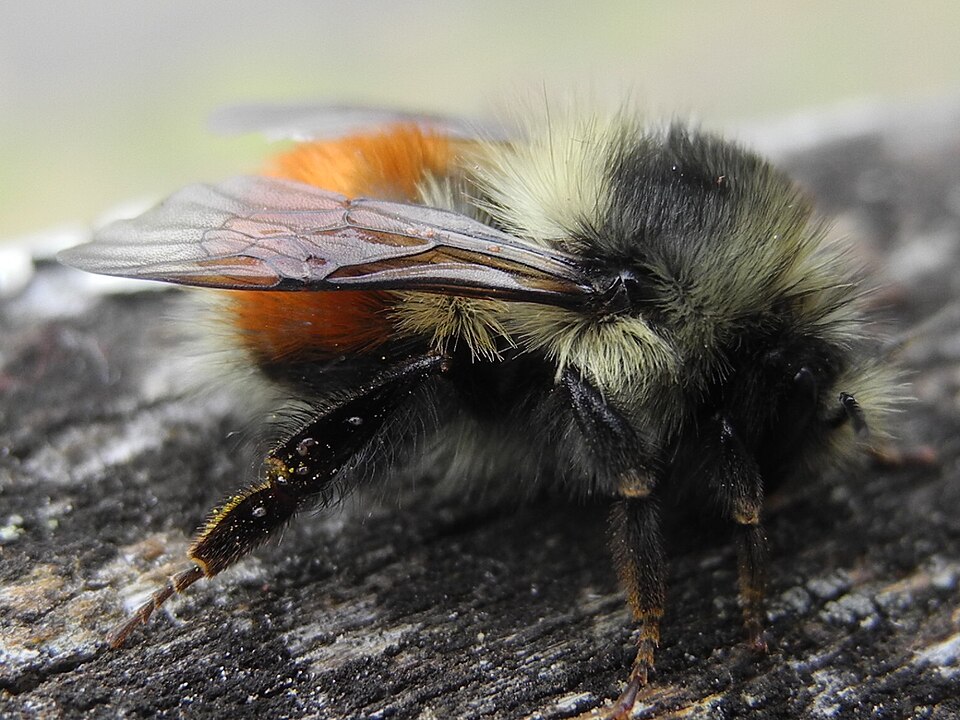
The black-tailed bumblebee is a fuzzy bumblebee from western North America with a black tip on its tail. In the north, it has a bright reddish orange band on its tummy. In California many of them have a black band there instead.
How fast is it?
Fun facts
The red and the dark bumblebees were once thought to be two different kinds, but tests showed they are the same.
People nicknamed the reddish ones red butts.
It is one of the few bumblebees you can still find regularly in the city of San Francisco.
It builds its nest under the ground or above ground in little spaces.
Most asked questions about Black-tailed bumblebee
?Where does the black-tailed bumblebee live?
In western North America, from Alaska to Mexico, including farms and cities.
?What does the black-tailed bumblebee eat?
Nectar and pollen from many flowers.
For bug experts
- Scientific name
- Bombus melanopygus
- Group
- Bees and bumblebees
- Family
- Apidae
- Classification
- Insecta > Hymenoptera > Apidae
- Lives on
- North America
- Also known as
- Black tail bumble bee, Orange-rumped bumblebee
Where the facts come from
- Bombus melanopygus (Wikipedia, CC BY-SA 4.0): what it looks like, where it lives, what it eats, sizes and fun facts, retold in simple words.
- Picture by Eshlants. CC BY-SA 4.0, Wikimedia Commons. The round sticker of this bug is cut from the same picture.
If we got something wrong, sorry, we are bug fans, not a science journal. Tell us at hello@bugwiki.app and we will fix it.
 Western honey bee
 Buff-tailed bumblebee
 Violet carpenter bee
 Giant honey bee
 Wallace's giant bee
 Himalayan giant honey bee
 Hawthorn shield bug
 Ox beetle
 White-lipped snail
 Citrus swallowtail
 Common banded hoverfly
 Australian painted lady