

Clifden nonpareil
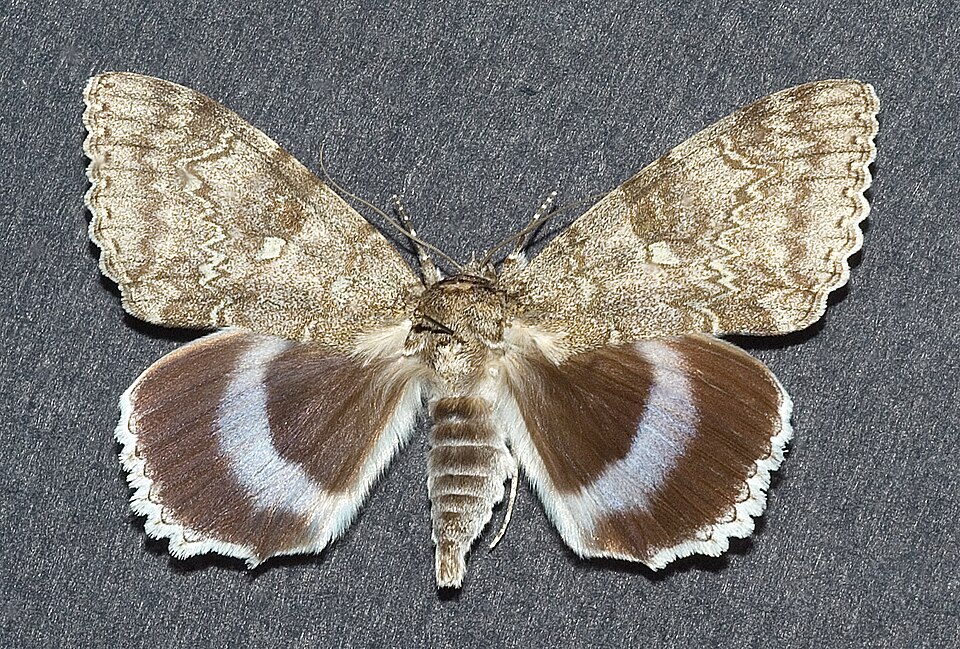
The Clifden nonpareil is a big moth with pale grey, speckled front wings. But when it opens them, it shows a surprise: dark back wings with a wide bright blue band. That is why it is also called the blue underwing.
How fast is it?
Fun facts
It disappeared from Great Britain in the 1960s when many poplar and aspen trees there were cut down.
For many years only a few lost travellers flew over from Europe, but now it is slowly coming back to Britain.
Its caterpillar is brownish grey with black speckles and has little pointed bumps on its back.
Some of these moths have extra dark front wings that hide almost all their markings.
Most asked questions about Clifden nonpareil
?Why is it called the Clifden nonpareil?
It was first found in Britain at a place called Cliveden, and nonpareil means without equal in French.
?What does the Clifden nonpareil eat?
Its caterpillars eat poplar and aspen leaves.
?Does the Clifden nonpareil live in Estonia?
Yes. It lives across central and northern Europe.
For bug experts
- Scientific name
- Catocala fraxini
- Named by
- Linnaeus, 1758
- Group
- Moths
- Family
- Erebidae
- Classification
- Insecta > Lepidoptera > Erebidae
- Lives on
- Europe, Asia
- Also known as
- Blue underwing
Where the facts come from
- Catocala fraxini (Wikipedia, CC BY-SA 4.0): what it looks like, where it lives, what it eats, sizes and fun facts, retold in simple words.
- Picture by unknown author. CC BY-SA 3.0, Wikimedia Commons. The round sticker of this bug is cut from the same picture.
If we got something wrong, sorry, we are bug fans, not a science journal. Tell us at hello@bugwiki.app and we will fix it.
 Atlas moth
 Luna moth
 Hummingbird hawk-moth
 Domestic silk moth
 Isabella tiger moth
 Polyphemus moth
 Black-headed cardinal beetle
 Red-headed ash borer
 Oak marble gall wasp
 Pellucid fly
 New Forest cicada
 Ringlet butterfly