

Crimson marsh glider
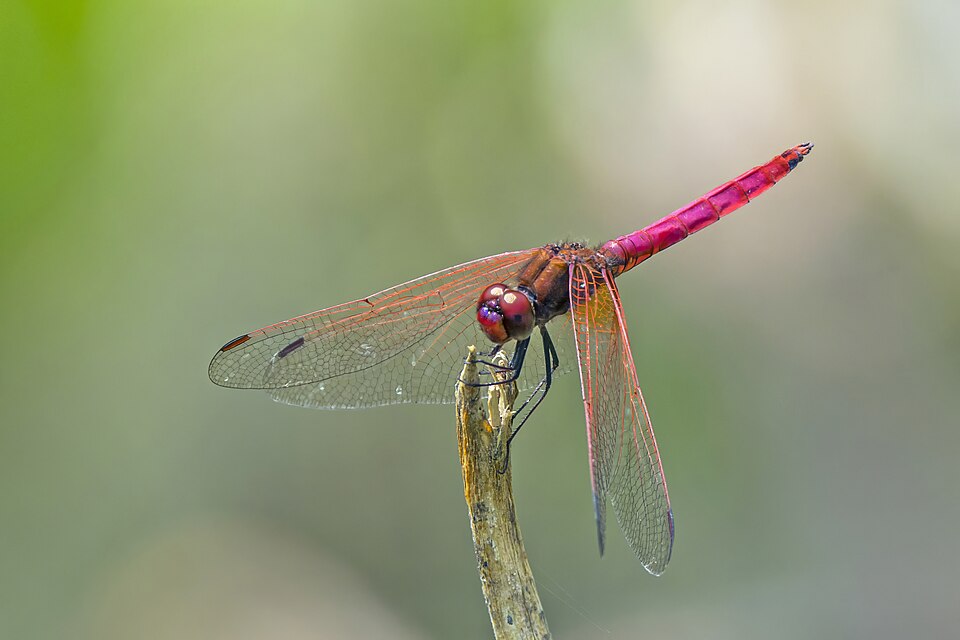
The crimson marsh glider is a small dragonfly in a dazzling pinky red. The boy is crimson with a violet shimmer and has red veins in his clear wings. The girl looks quite different, in olive and reddish brown with black stripes.
How fast is it?
Fun facts
You can see it flying all year round.
The boy's wings have a big amber patch near his body.
The bottom of the boy's tail is a bit swollen, like a little balloon.
It lays its eggs in streams, rivers, canals and ponds.
Most asked questions about Crimson marsh glider
?Why is the crimson marsh glider so red?
The boys are crimson to stand out. The girls are olive and brown.
?Is the crimson marsh glider dangerous?
No. Dragonflies cannot sting and are harmless to people.
?Where does the crimson marsh glider live?
In India, Sri Lanka and South-east Asia, near weedy ponds, marshes and slow rivers.
For bug experts
- Scientific name
- Trithemis aurora
- Group
- Dragonflies and damselflies
- Family
- Libellulidae
- Classification
- Insecta > Odonata > Libellulidae
- Lives on
- Asia
Where the facts come from
- Crimson marsh glider (Wikipedia, CC BY-SA 4.0): what it looks like, where it lives, what it eats, sizes and fun facts, retold in simple words.
- Picture by Charles J. Sharp. CC BY-SA 4.0, Wikimedia Commons. The round sticker of this bug is cut from the same picture.
If we got something wrong, sorry, we are bug fans, not a science journal. Tell us at hello@bugwiki.app and we will fix it.
 Emperor dragonfly
 Common whitetail
 Green darner
 Ebony jewelwing
 Globe skimmer
 Blue dasher
 Pennsylvania firefly
 Common pond skater
 Amber snail
 Large copper
 Pitcher plant mosquito
 Phantom crane fly
_male_Kuang_Si.jpg)