

Differential grasshopper
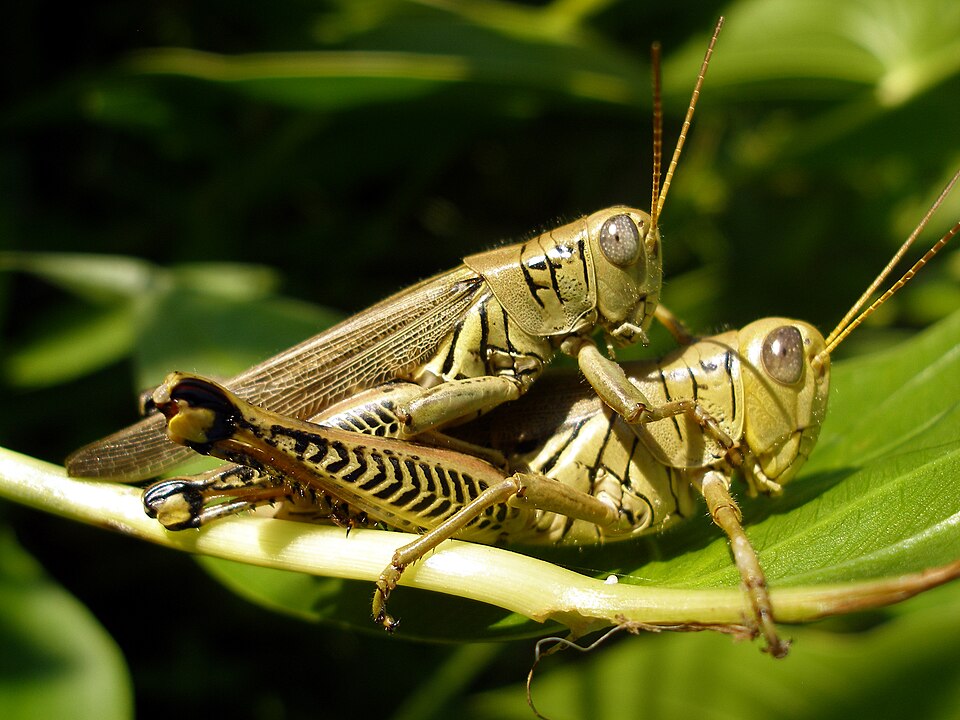
The differential grasshopper is a big brown or green grasshopper from North America. It has yellow feet and black zigzag stripes on its strong jumping legs. It grows darker as it gets older.
How big is it?
How long is it?
How big is Differential grasshopper compared to YOU?
Just maths in your browser. Nothing is saved or sent anywhere.
How fast is it?
Fun facts
Some of its babies are bright yellow.
A mother can lay up to six bundles of eggs in soft soil, with up to 200 eggs in each one.
After hatching, the babies need only about a month to grow into winged grown-ups.
It can smell when lettuce or sunflowers have gone floppy and old, and then it leaves them alone.
It can even live in empty lots in towns, not just in the countryside.
Most asked questions about Differential grasshopper
?What does the differential grasshopper eat?
Grasses and leafy plants such as sunflowers and lettuce. In gardens it also eats tomatoes, peas and squash.
?How big is the differential grasshopper?
Males are about 3 to 4 centimetres long and females up to 5 centimetres.
?Is the differential grasshopper a pest?
Yes, in large numbers. Swarms can eat corn, cotton, grain and fruit crops.
For bug experts
- Scientific name
- Melanoplus differentialis
- Group
- Grasshoppers and crickets
- Family
- Acrididae
- Classification
- Insecta > Orthoptera > Acrididae
- Lives on
- North America
Where the facts come from
- Differential grasshopper (Wikipedia, CC BY-SA 4.0): what it looks like, where it lives, what it eats, sizes and fun facts, retold in simple words.
- Picture by Rkitko. CC BY 3.0, Wikimedia Commons. The round sticker of this bug is cut from the same picture.
If we got something wrong, sorry, we are bug fans, not a science journal. Tell us at hello@bugwiki.app and we will fix it.
 Desert locust
 House cricket
 Parktown prawn
 Eastern lubber grasshopper
 Australian plague locust
 Mormon cricket
 Black oil beetle
 Australian sheep blowfly
 Pearl crescent
 Nut weevil
 False potato beetle
 Ghost moth