

Hercules moth
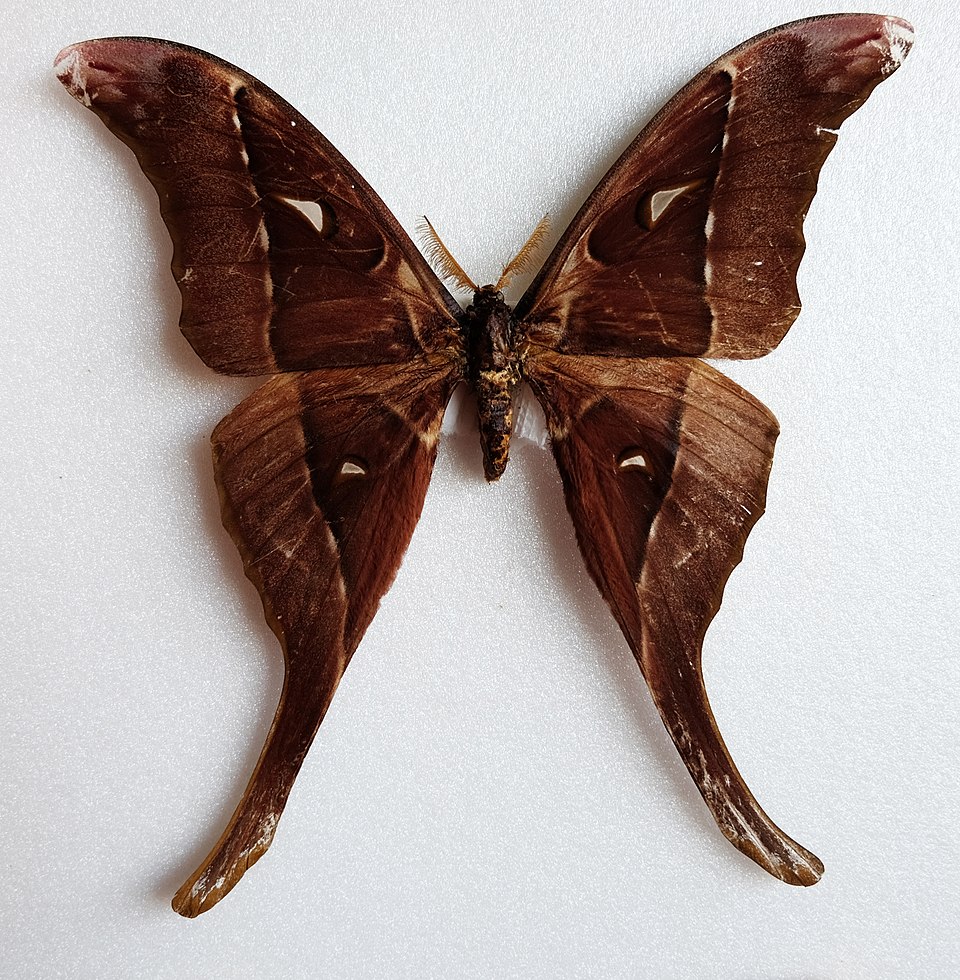
The Hercules moth is a giant golden brown and white moth from the rainforests of New Guinea and northern Australia. Each of its four wings has a see-through spot like a little window. Its wings cover more space than the wings of any other living insect.
How big is it?
How wide are its wings?
How big is Hercules moth compared to YOU?
Just maths in your browser. Nothing is saved or sent anywhere.
How fast is it?
Fun facts
Its wings are about 27 centimetres from tip to tip, making it the biggest moth in Australia.
Together its wings cover about 300 square centimetres, the largest wing area of any living insect.
Its caterpillar can grow 12 centimetres long and weigh about 54 grams, as much as a big hen's egg.
The caterpillar is pale blue or green with red dots along its sides and yellow spines.
The boy moths have longer, thinner tails on their back wings than the girls.
Most asked questions about Hercules moth
?What is the biggest moth in Australia?
The Hercules moth, with wings about 27 centimetres across.
?What does the Hercules moth eat?
The grown-up moth does not eat at all. Its caterpillars eat the leaves of rainforest trees.
?Is the Hercules moth dangerous?
No. It is completely harmless.
For bug experts
- Scientific name
- Coscinocera hercules
- Named by
- Miskin, 1876
- Group
- Moths
- Family
- Saturniidae
- Classification
- Insecta > Lepidoptera > Saturniidae
- Lives on
- Australia and Oceania
Where the facts come from
- Coscinocera hercules (Wikipedia, CC BY-SA 4.0): what it looks like, where it lives, what it eats, sizes and fun facts, retold in simple words.
- Picture by Anaxibia. CC BY-SA 4.0, Wikimedia Commons. The round sticker of this bug is cut from the same picture.
If we got something wrong, sorry, we are bug fans, not a science journal. Tell us at hello@bugwiki.app and we will fix it.
 Atlas moth
 Luna moth
 Hummingbird hawk-moth
 Domestic silk moth
 Isabella tiger moth
 Polyphemus moth
 Peppermint stick insect
 Conehead termite
 Forest giant owl butterfly
 Great orange-tip
 Giant Fijian longhorn beetle
 Richmond birdwing