

Hickory tussock moth
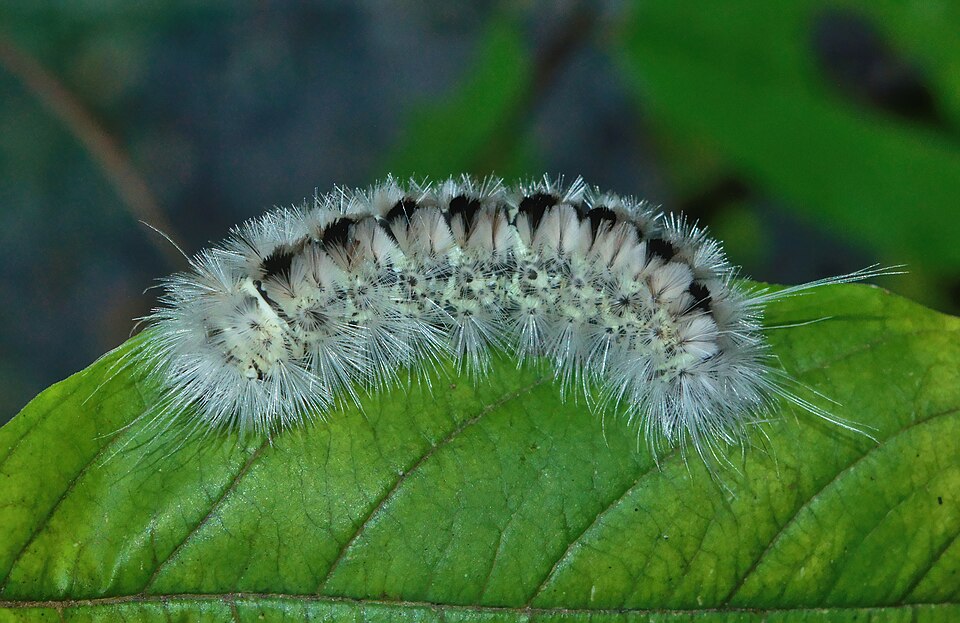
The hickory tussock moth is famous for its fluffy caterpillar. It is covered in long white hairs with black tufts on its back, like a tiny walking paintbrush. The grown-up moth has brownish wings with white patches that look like a stained glass window.
How fast is it?
Fun facts
Young caterpillars eat in groups and nibble leaves until only the thin veins are left.
Older caterpillars go off on their own and can grow to about 4.5 centimetres long.
It weaves its own hairs into its cocoon and spends the winter in fallen leaves.
The grown-up moths fly in May and June, and there is only one new family each year.
Most asked questions about Hickory tussock moth
?What does the hickory tussock moth caterpillar look like?
It is white and very hairy, with black tufts along its back, black spots on its sides and a black head.
?When can you see these caterpillars?
Mostly from July to October.
For bug experts
- Scientific name
- Lophocampa caryae
- Group
- Moths
- Family
- Erebidae
- Classification
- Insecta > Lepidoptera > Erebidae
- Lives on
- North America
- Also known as
- Hickory tiger moth, Hickory halisidota
Where the facts come from
- Lophocampa caryae (Wikipedia, CC BY-SA 4.0): what it looks like, where it lives, what it eats, sizes and fun facts, retold in simple words.
- Picture by The Cosmonaut. CC BY-SA 2.5 ca, Wikimedia Commons. The round sticker of this bug is cut from the same picture.
If we got something wrong, sorry, we are bug fans, not a science journal. Tell us at hello@bugwiki.app and we will fix it.
 Atlas moth
 Luna moth
 Hummingbird hawk-moth
 Domestic silk moth
 Isabella tiger moth
 Polyphemus moth
 California dogface
 Oak bush-cricket
 Hackberry emperor
 Southern devil scorpion
 Black beauty stick insect
 Sparklemuffin