

Bug card No. 0773 of 1,500
Indian stingless bee
Tetragonula iridipennis
It lives in big families and makes a special honey.
Lives in
India, Sri Lanka and other warm parts of Southeast Asia
Length
3.5 to 4 mm (0.14 to 0.16 in)
What does it eat?
It drinks nectar from plants like coconut palms and jackfruit trees, and collects sap from trees.
How big is it?
How long is it?
💅small enough to sit on your fingernail⚽could fly across a whole football pitch in 29 seconds⚡moves 900 times its own body length every second
How big is Indian stingless bee compared to YOU?
Just maths in your browser. Nothing is saved or sent anywhere.
How fast is it?
A person walking about 5 km/h (3.1 mph)
A kid running fast about 13 km/h (8.1 mph)
Indian stingless bee about 13 km/h (8.1 mph)
A grown-up on a bike about 25 km/h (16 mph)
cool stuff
Fun facts
1
For hundreds of years, people have kept these bees in clay pots to collect their honey, which they use as medicine.
2
It was first found on the island of Sri Lanka in 1854.
3
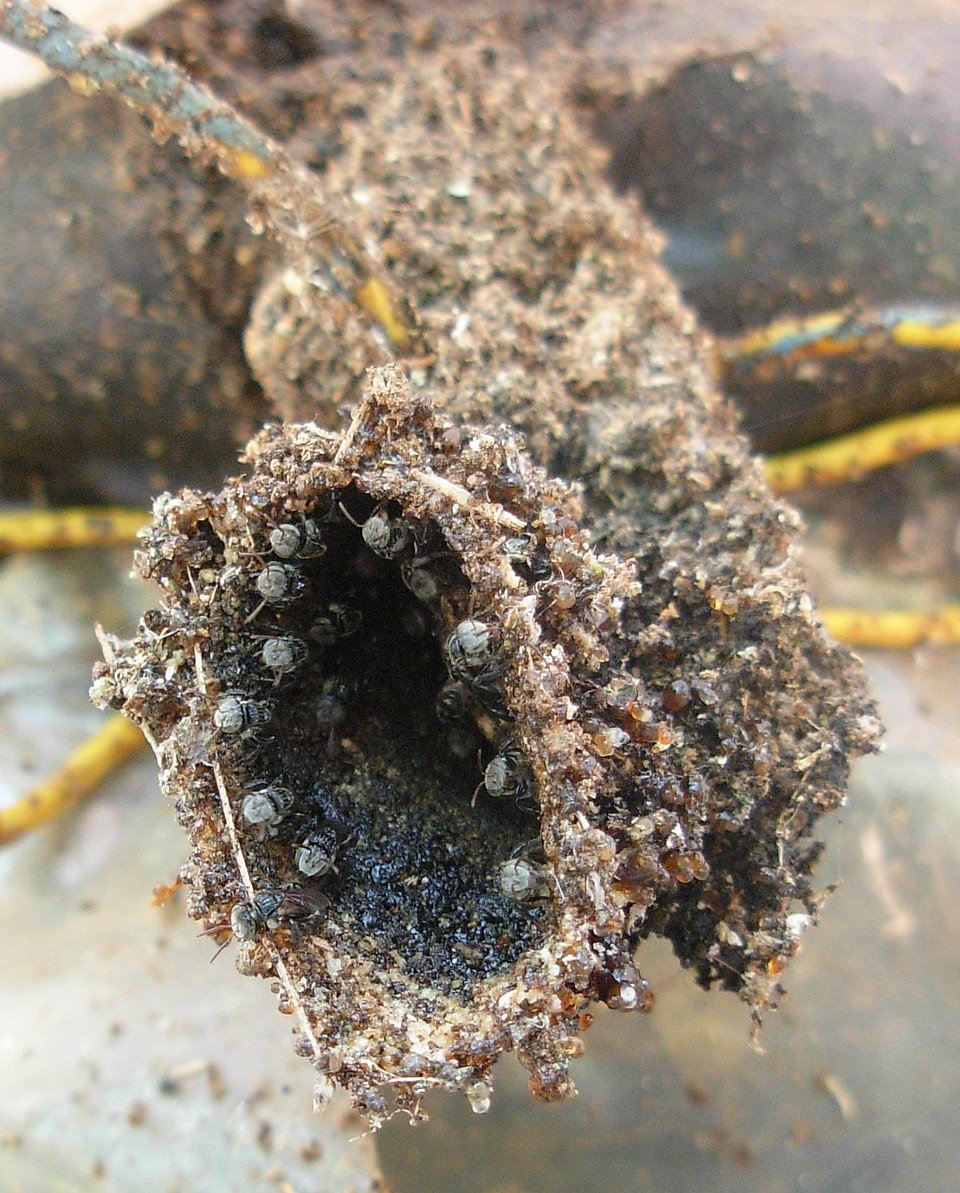
It builds its nest in tree trunks, logs and holes in walls, quite close to the ground.
4
When a family moves, the workers carry food to the new home bit by bit before the young queen arrives.
5
Boy bees gather in big crowds near a nest, waiting for a new queen to come out.
For bug experts
- Scientific name
- Tetragonula iridipennis
- Named by
- Smith, 1854
- Group
- Bees and bumblebees
- Family
- Apidae
- Classification
- Insecta > Hymenoptera > Apidae
- Lives on
- Asia
- Also known as
- Dammar bee
Where the facts come from
- Tetragonula iridipennis (Wikipedia, CC BY-SA 4.0): what it looks like, where it lives, what it eats, sizes and fun facts, retold in simple words.
- Picture by Noblevmy at Malayalam Wikipedia. CC BY 2.5, Wikimedia Commons. The round sticker of this bug is cut from the same picture.
If we got something wrong, sorry, we are bug fans, not a science journal. Tell us at hello@bugwiki.app and we will fix it.
 Western honey bee
 Buff-tailed bumblebee
 Violet carpenter bee
 Giant honey bee
 Wallace's giant bee
 Himalayan giant honey bee
 Togo starburst baboon spider
 Giant centipede
 Brown rhinoceros beetle
 Death's head cockroach
 Giant blue morpho
 Giraffe stag beetle