

Ivy bee
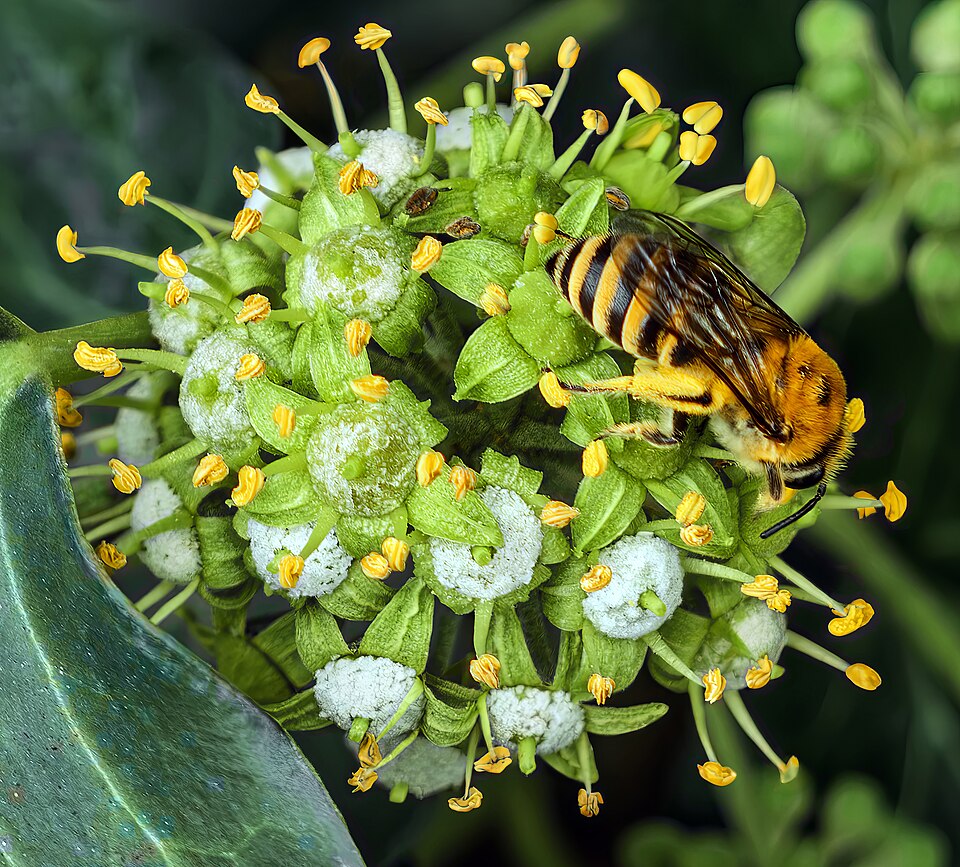
The ivy bee is a fuzzy bee with an orange-brown hairy chest and orange stripes on its tummy. It comes out late in the year, when most other bees are finishing. That is when the ivy flowers, and ivy is its favourite food.
How big is it?
How long is it?
How big is Ivy bee compared to YOU?
Just maths in your browser. Nothing is saved or sent anywhere.
How fast is it?
Fun facts
It flies from late August until early November.
Scientists only noticed it was its own kind of bee in 1993. Before that it was mixed up with a look-alike.
It digs its nest in soft, sandy soil.
If there is not enough ivy, it also visits daisy-family flowers.
Most asked questions about Ivy bee
?When can you see ivy bees?
In autumn, from late August to early November, when ivy is in flower.
?What does the ivy bee eat?
Mostly nectar and pollen from ivy flowers.
For bug experts
- Scientific name
- Colletes hederae
- Named by
- Schmidt & Westrich, 1993
- Group
- Bees and bumblebees
- Family
- Colletidae
- Classification
- Insecta > Hymenoptera > Colletidae
- Lives on
- Europe
Where the facts come from
- Colletes hederae (Wikipedia, CC BY-SA 4.0): what it looks like, where it lives, what it eats, sizes and fun facts, retold in simple words.
- Picture by Didier Descouens. CC BY-SA 4.0, Wikimedia Commons. The round sticker of this bug is cut from the same picture.
If we got something wrong, sorry, we are bug fans, not a science journal. Tell us at hello@bugwiki.app and we will fix it.
 Western honey bee
 Buff-tailed bumblebee
 Violet carpenter bee
 Giant honey bee
 Wallace's giant bee
 Himalayan giant honey bee
 Narrow-bordered bee hawk-moth
 Six-spotted zigzag ladybird
 American rose chafer
 Cabbage aphid
 Swamp cicada
 Raspberry beetle
_Colletes_hederae_on_Hederae_inflorescence.jpg)