

Bug card No. 0941 of 1,500
Moss carder bee
Bombus muscorum
Name means: “Muscorum comes from the Latin word for moss.”
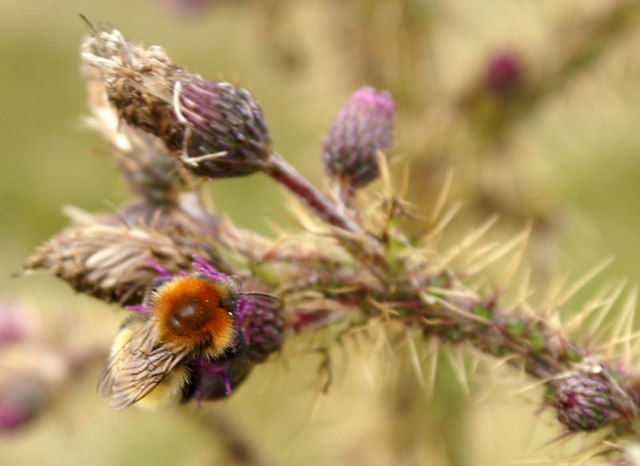
The moss carder bee is a bumblebee covered in soft ginger fur, like a little flying teddy bear. It has a long tongue for reaching deep into flowers. It builds its nest right on the ground in open grassy places.
Lives in
Europe and Asia, from Ireland to Mongolia, on moors, grasslands and salt marshes
Length
1 to 1.6 cm (0.39 to 0.63 in)
What does it eat?
It drinks nectar and collects pollen, and loves clover, bird's-foot trefoil, vetches and thistles.
How big is it?
How long is it?
🍚as long as 2.5 grains of rice in a row⚽could fly across a whole football pitch in 25 seconds⚡moves 260 times its own body length every second
How big is Moss carder bee compared to YOU?
Just maths in your browser. Nothing is saved or sent anywhere.
How fast is it?
A person walking about 5 km/h (3.1 mph)
A kid running fast about 13 km/h (8.1 mph)
Moss carder bee about 15 km/h (9.3 mph)
A grown-up on a bike about 25 km/h (16 mph)
cool stuff
Fun facts
1
Its family is small, with only 20 to 100 workers.
2
It looks for food very close to its nest.
3
It has become rare in many places, because its grassy homes are disappearing.
4
The queen is the biggest, 17 to 19 millimetres long.
you asked
Most asked questions about Moss carder bee
?What does the moss carder bee eat?
Nectar and pollen, especially from clover, vetches and thistles.
?Why is the moss carder bee rare?
Many of the open grasslands where it nests have been lost.
For bug experts
- Scientific name
- Bombus muscorum
- Named by
- Linnaeus, 1758
- Group
- Bees and bumblebees
- Family
- Apidae
- Classification
- Insecta > Hymenoptera > Apidae
- Lives on
- Europe, Asia
- Also known as
- Large carder bee
Where the facts come from
- Bombus muscorum (Wikipedia, CC BY-SA 4.0): what it looks like, where it lives, what it eats, sizes and fun facts, retold in simple words.
- Picture by Mike Pennington. CC BY-SA 2.0, Wikimedia Commons. The round sticker of this bug is cut from the same picture.
If we got something wrong, sorry, we are bug fans, not a science journal. Tell us at hello@bugwiki.app and we will fix it.
 Western honey bee
 Buff-tailed bumblebee
 Violet carpenter bee
 Giant honey bee
 Wallace's giant bee
 Himalayan giant honey bee
 Elm leaf beetle
 Passionvine hopper
 Winter ant
 Sloe bug
 Sachem
 Mediterranean spotted chafer
_-_geograph.org.uk_-_951933.jpg)