

Pale tussock
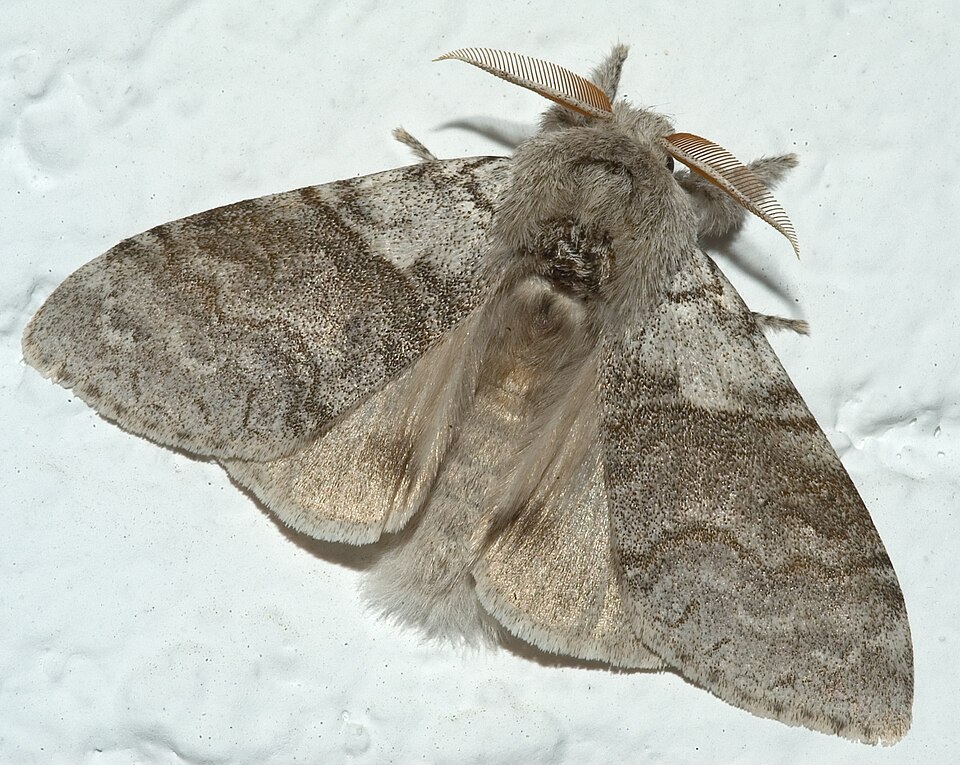
The pale tussock is a soft, greyish white moth with wavy dark lines on its wings. Its caterpillar is the real star: bright lemon yellow, with fluffy tufts on its back and a red tail tuft. It looks like a little bottle brush.
How big is it?
How wide are its wings?
How big is Pale tussock compared to YOU?
Just maths in your browser. Nothing is saved or sent anywhere.
How fast is it?
Fun facts
Its caterpillar is usually lemon yellow, but some are brownish, purple or blackish grey.
In England it used to be called the hop dog, because its caterpillars ate hop plants.
The moth flies from April to June.
In Dutch it is named after Maria Sibylla Merian, a famous painter of butterflies and insects.
Males and females look different: the male is darker grey with a black band on the front wings.
Most asked questions about Pale tussock
?Is the pale tussock dangerous?
No. The moth is harmless. Hairy caterpillars can make skin itchy, so it is best to just look at them.
?What does the pale tussock caterpillar eat?
Leaves of oak, beech, willow, birch, hawthorn and some fruit trees.
?When can I see a pale tussock moth?
The moths fly from April to June.
For bug experts
- Scientific name
- Calliteara pudibunda
- Named by
- Linnaeus, 1758
- Group
- Moths
- Family
- Erebidae
- Classification
- Insecta > Lepidoptera > Erebidae
- Lives on
- Europe, Asia
Where the facts come from
- Calliteara pudibunda (Wikipedia, CC BY-SA 4.0): what it looks like, where it lives, what it eats, sizes and fun facts, retold in simple words.
- Picture by unknown author. CC BY-SA 3.0, Wikimedia Commons. The round sticker of this bug is cut from the same picture.
If we got something wrong, sorry, we are bug fans, not a science journal. Tell us at hello@bugwiki.app and we will fix it.
 Atlas moth
 Luna moth
 Hummingbird hawk-moth
 Domestic silk moth
 Isabella tiger moth
 Polyphemus moth
 European rhinoceros beetle
 American giant millipede
 Red wood ant
 American carrion beetle
 Pigeon tremex
 Purple emperor