

Telephone-pole beetle
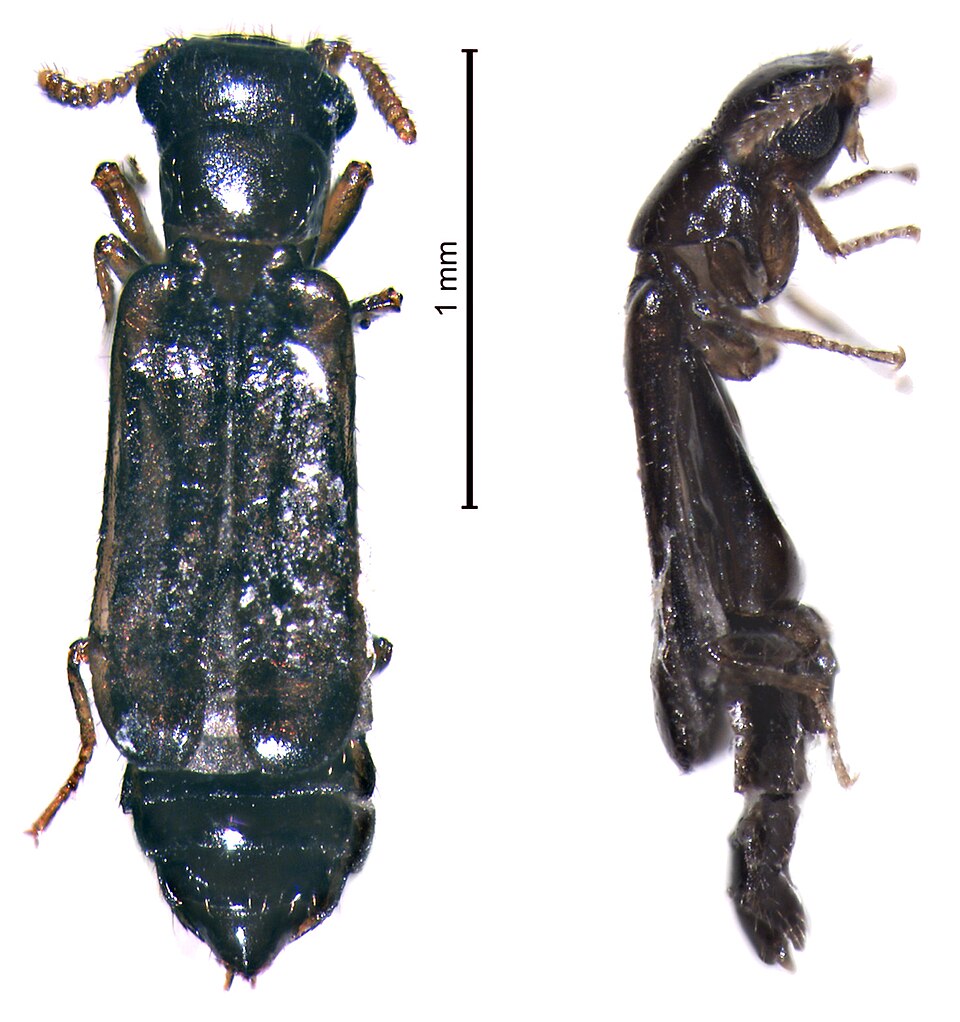
The telephone-pole beetle is a tiny beetle whose babies live inside old, wet, rotting wood. The grown-up beetle is dark brown with big bulging eyes, but it is very rare to see one. Almost all of its life happens as a little white larva hidden in the wood.
How fast is it?
Fun facts
It is the last living member of its whole beetle family. All its other relatives died out long ago.
Its babies can have babies of their own while they are still larvae, without ever growing up.
Grown-up beetles appear so rarely that scientists call them ghost adults.
Its relatives have been found trapped in old amber from millions of years ago.
It got its name because its larvae can live in wooden poles and other wooden buildings.
Most asked questions about Telephone-pole beetle
?Why is it called the telephone-pole beetle?
Its larvae can live inside wooden poles and beams and slowly weaken them.
?Is the telephone-pole beetle dangerous?
No, not to people. It only eats rotting wood.
?What does the telephone-pole beetle eat?
Its larvae eat damp, rotting oak and chestnut wood.
For bug experts
- Scientific name
- Micromalthus debilis
- Named by
- LeConte, 1878
- Group
- Beetles
- Family
- Micromalthidae
- Classification
- Insecta > Coleoptera > Micromalthidae
- Lives on
- North America, South America, Europe, Africa, Asia
Where the facts come from
- Telephone-pole beetle (Wikipedia, CC BY-SA 4.0): what it looks like, where it lives, what it eats, sizes and fun facts, retold in simple words.
- Picture by Enrico Ruzzier & Andrea Colla. CC BY 4.0, Wikimedia Commons. The round sticker of this bug is cut from the same picture.
If we got something wrong, sorry, we are bug fans, not a science journal. Tell us at hello@bugwiki.app and we will fix it.
 Stag beetle
 Hercules beetle
 Common glow-worm
 Goliath beetle
 Cockchafer
 Mealworm beetle
 Pigeon tremex
 Purple emperor
 Comma butterfly
 Red-headed centipede
 Promethea silkmoth
 Giant wood moth