

Tropical carpenter bee
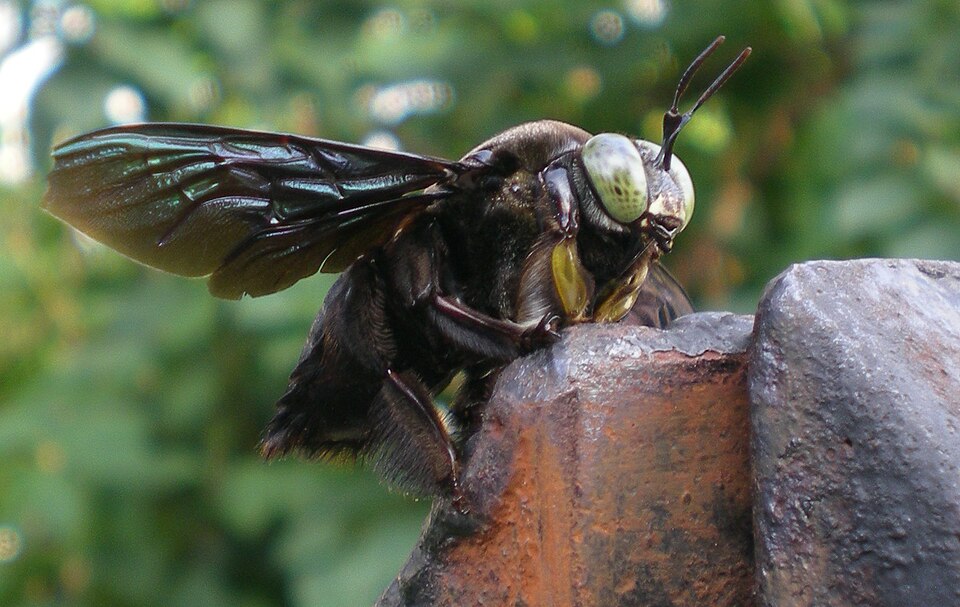
The tropical carpenter bee is one of the biggest bees in the world. It is shiny black all over, and its wings shimmer blue-green or purple in the sun. You can hear it coming, because it makes a loud, deep buzz.
How fast is it?
Fun facts
It chews long tunnels into dead wood with its strong jaws, even into roof beams and telephone poles. That is why it is called a carpenter.
Its nest has 3 to 5 tunnels, each about 11 centimetres long and as wide as a thumb.
It never digs into living trees, only dead wood, stems and bamboo.
In towns, a bee may come back to the same favourite perch day after day.
Farmers in the Philippines use it to help passion-fruit flowers turn into fruit.
Most asked questions about Tropical carpenter bee
?Why is it called a carpenter bee?
Because it chews tunnels into wood to make its nest, like a carpenter working wood.
?Is it the biggest bee in the world?
It is one of the biggest, but the biggest of all is Wallace's giant bee from Indonesia.
For bug experts
- Scientific name
- Xylocopa latipes
- Named by
- Drury, 1773
- Group
- Bees and bumblebees
- Family
- Apidae
- Classification
- Insecta > Hymenoptera > Apidae
- Lives on
- Asia
- Also known as
- Broad-handed carpenter bee
Where the facts come from
- Xylocopa latipes (Wikipedia, CC BY-SA 4.0): what it looks like, where it lives, what it eats, sizes and fun facts, retold in simple words.
- Picture by Daflukes. CC BY-SA 3.0, Wikimedia Commons. The round sticker of this bug is cut from the same picture.
If we got something wrong, sorry, we are bug fans, not a science journal. Tell us at hello@bugwiki.app and we will fix it.
 Western honey bee
 Buff-tailed bumblebee
 Violet carpenter bee
 Giant honey bee
 Wallace's giant bee
 Himalayan giant honey bee
 Giraffe stag beetle
 Giant pill millipede
 Chan's megastick
 Sabertooth longhorn beetle
 Giant spiny stick insect
 Coffee berry borer