

Vivid dancer
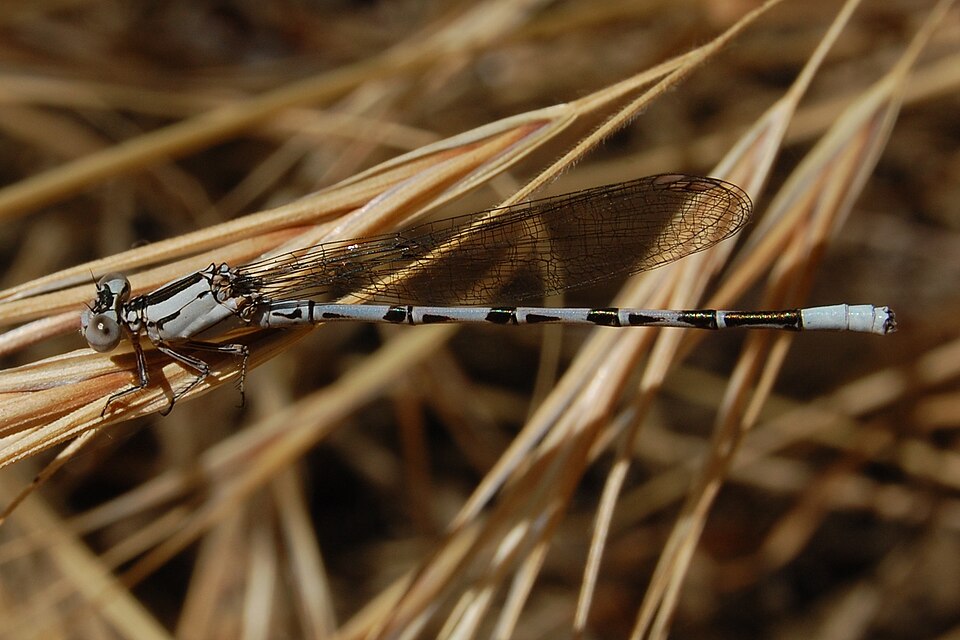
The vivid dancer is a slim damselfly, usually bright blue. It can change its colour with the weather: when it is warm it turns light blue, and when it is cool it turns darker. It is the state insect of Nevada in the United States.
How fast is it?
Fun facts
Some females are red or brown instead of blue.
At night it rests up in the trees to keep warm, and in the day it flies to sunny spots to sunbathe.
The mother lays her eggs on water plants just below the surface.
In warm springs it grows up in about one year, but in cold springs it can take two or three years.
Males sit in sunny spots and dart out at females to get their attention.
Most asked questions about Vivid dancer
?Why does the vivid dancer change colour?
Its colour changes with the temperature. It is lighter when warm and darker when cool.
?What does the vivid dancer eat?
Small soft flying insects like mosquitoes, flies and small moths.
?Is the vivid dancer a dragonfly?
It is a damselfly, a slimmer cousin of dragonflies.
For bug experts
- Scientific name
- Argia vivida
- Group
- Dragonflies and damselflies
- Family
- Coenagrionidae
- Classification
- Insecta > Odonata > Coenagrionidae
- Lives on
- North America
Where the facts come from
- Argia vivida (Wikipedia, CC BY-SA 4.0): what it looks like, where it lives, what it eats, sizes and fun facts, retold in simple words.
- Picture by Eugene Zelenko. CC BY-SA 4.0, Wikimedia Commons. The round sticker of this bug is cut from the same picture.
If we got something wrong, sorry, we are bug fans, not a science journal. Tell us at hello@bugwiki.app and we will fix it.
 Emperor dragonfly
 Common whitetail
 Green darner
 Ebony jewelwing
 Globe skimmer
 Blue dasher
 Scarlet tiger moth
 Six-spotted fishing spider
 Two-tailed swallowtail
 Inland floodwater mosquito
 Phantom midge
 March brown