

Western conifer seed bug
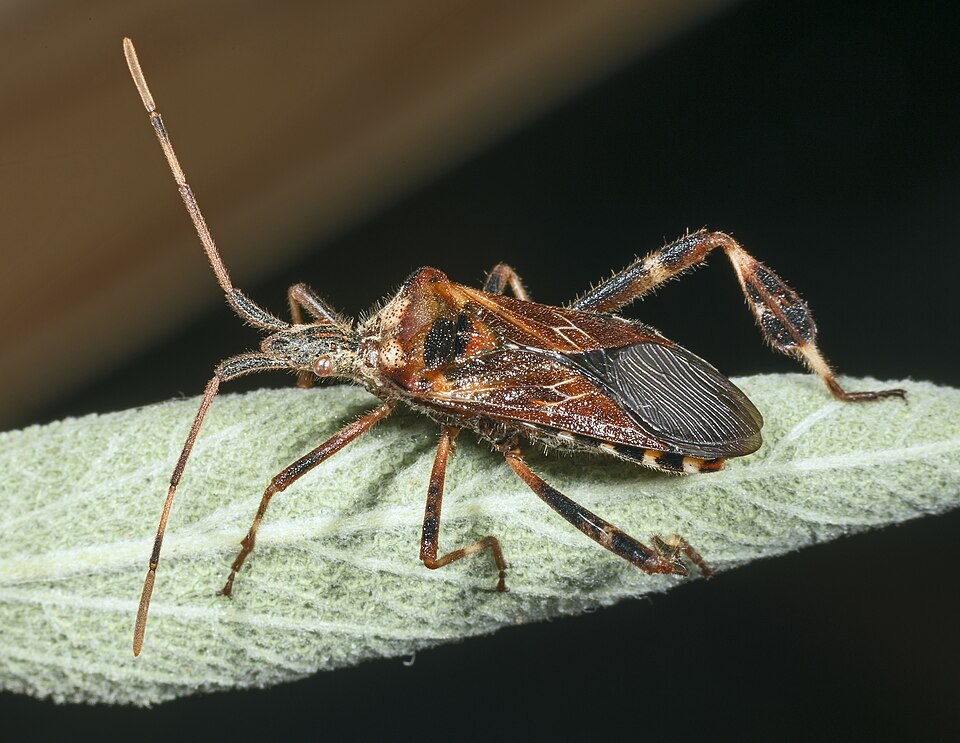
The western conifer seed bug is a long brown bug with light and dark stripes along the edges of its body. Its back legs have flat, wide bits that look like little leaves. When it flies, it makes a loud buzzing sound.
How big is it?
How long is it?
How big is Western conifer seed bug compared to YOU?
Just maths in your browser. Nothing is saved or sent anywhere.
How fast is it?
Fun facts
When it is scared, it sprays a stinky smell to keep enemies away.
In autumn it looks for a cosy crack to spend the winter, and sometimes many of them walk into houses.
It came to Europe by accident with wood from America and was first seen in Italy in 1999.
Its babies hatch from eggs on pine needles and change their skin five times before they are grown up.
It has even been caught poking holes in plastic water pipes with its beak.
Most asked questions about Western conifer seed bug
?Is the western conifer seed bug dangerous?
No. It is harmless to people. It only uses its beak to suck plant sap.
?Why are these bugs in my house?
In autumn they look for warm hiding places for the winter, and houses near pine trees are perfect for them.
?Does the western conifer seed bug stink?
Yes, a little. When it is scared or squeezed, it lets out a bad smell.
Myth buster
Myth: It is sometimes called the pine-beetle, so it must be a beetle.
Truth: No. It is a true bug, not a beetle. True bugs have a long beak for sucking juice.
For bug experts
- Scientific name
- Leptoglossus occidentalis
- Group
- True bugs and cicadas
- Family
- Coreidae
- Classification
- Insecta > Hemiptera > Coreidae
- Lives on
- North America, Europe, South America
- Also known as
- Pine-beetle, WCSB
Where the facts come from
- Western conifer seed bug (Wikipedia, CC BY-SA 4.0): what it looks like, where it lives, what it eats, sizes and fun facts, retold in simple words.
- Picture by Didier Descouens. CC BY-SA 4.0, Wikimedia Commons. The round sticker of this bug is cut from the same picture.
If we got something wrong, sorry, we are bug fans, not a science journal. Tell us at hello@bugwiki.app and we will fix it.
 Pharaoh cicada
 Spotted lanternfly
 Brown marmorated stink bug
 Cochineal
 Boxelder bug
 Wheel bug
 Ten-lined June beetle
 Marbled orb-weaver
 Jack jumper ant
 Spongy moth
 Castor bean tick
 Regal moth