

Wētāpunga
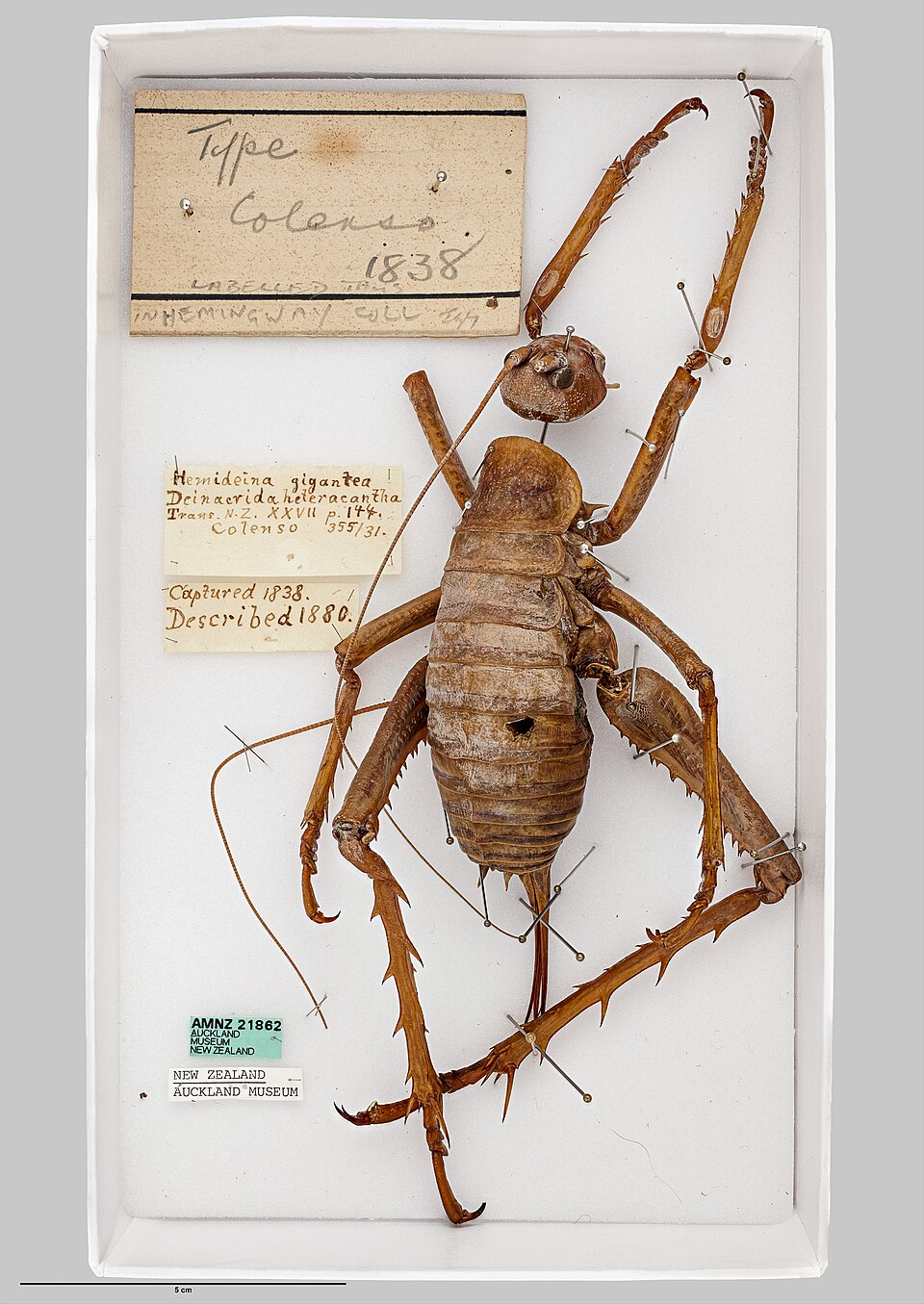
The wētāpunga is a giant, wingless cricket-like insect from New Zealand. It is one of the heaviest insects in the world: a big female can weigh more than a sparrow. It climbs trees at night to munch leaves.
How fast is it?
Fun facts
A female carrying eggs can weigh up to 70 grams. Grown-up females are usually about 6,5 centimetres long.
Females are much bigger than males. An average female weighs about four times as much as a male.
It used to live on New Zealand's North Island too, but it disappeared from there in the 1800s. It survived only on one small island.
People have now moved wētāpunga to seven islands with no predators, and their numbers are growing.
It cannot fly, but its back legs are covered in strong, sharp spines.
Most asked questions about Wētāpunga
?How big is a wētāpunga?
A grown-up female is about 6,5 centimetres long without legs and can weigh up to 70 grams, much more than a mouse.
?Can a wētāpunga fly?
No. It has no wings at all, but it is a good climber.
?Is the wētāpunga endangered?
It is rare, but thanks to people moving it to safe islands, there are more of them now.
For bug experts
- Scientific name
- Deinacrida heteracantha
- Named by
- White, 1842
- Group
- Grasshoppers and crickets
- Family
- Anostostomatidae
- Classification
- Insecta > Orthoptera > Anostostomatidae
- Lives on
- Australia and Oceania
- Also known as
- Little Barrier giant wētā
Where the facts come from
- Deinacrida heteracantha (Wikipedia, CC BY-SA 4.0): what it looks like, where it lives, what it eats, sizes and fun facts, retold in simple words.
- Picture by Auckland Museum. CC BY 4.0, Wikimedia Commons. The round sticker of this bug is cut from the same picture.
If we got something wrong, sorry, we are bug fans, not a science journal. Tell us at hello@bugwiki.app and we will fix it.
 Desert locust
 House cricket
 Parktown prawn
 Eastern lubber grasshopper
 Australian plague locust
 Mormon cricket
 Lord Howe Island stick insect
 Lac insect
 Jack jumper ant
 Spongy moth
 Castor bean tick
 Regal moth
_Holotype_specimen_from_the_Auckland_Museum.jpg)