

Yellow crazy ant
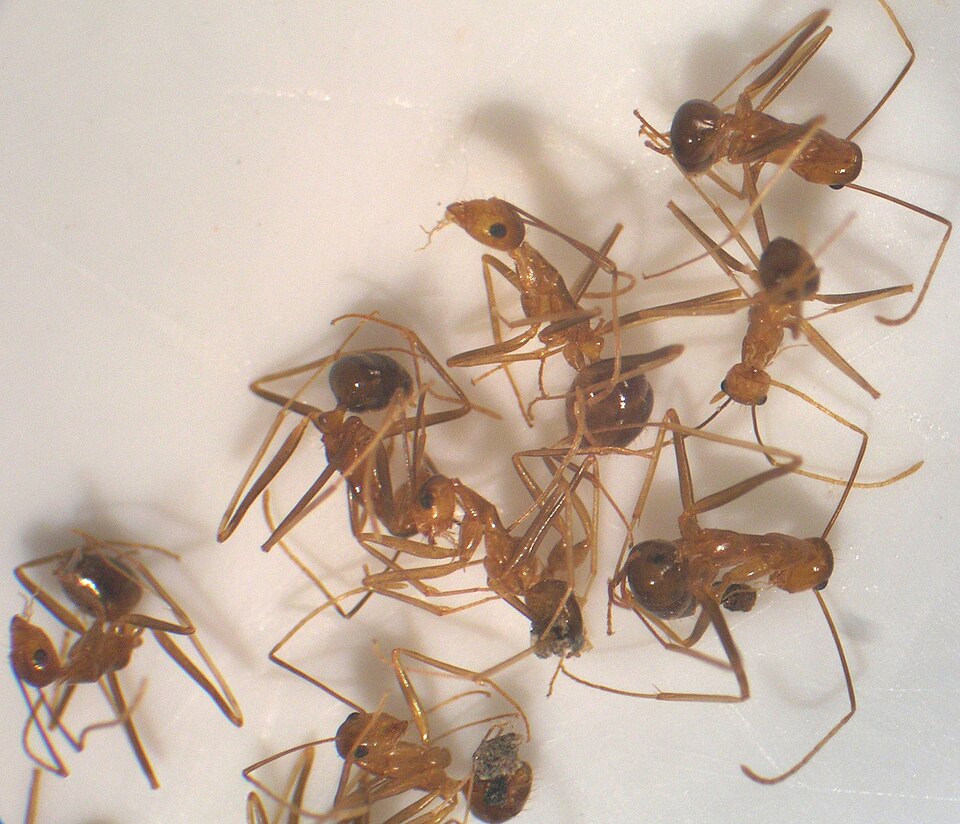
The yellow crazy ant is a yellow to orange ant with very long legs and feelers. When you disturb it, it runs around in wild, zigzag paths, which is how it got its funny name. It has travelled with people to many tropical islands.
How fast is it?
Fun facts
It is on the list of the 100 worst invasive animals and plants in the world.
On Christmas Island in the Indian Ocean it formed giant supercolonies and attacked the island's land crabs.
There, its colonies spread about 3 metres a day, which adds up to about a kilometre a year.
It is one of the biggest invasive ants, thanks to its long legs and feelers.
It hitches rides to new places on trucks and boats.
Most asked questions about Yellow crazy ant
?Why is it called the crazy ant?
Because it runs around in fast, jerky, zigzag paths when it is disturbed.
?Where does the yellow crazy ant come from?
Probably from the moist tropical lowlands of Southeast Asia.
For bug experts
- Scientific name
- Anoplolepis gracilipes
- Group
- Ants
- Family
- Formicidae
- Classification
- Insecta > Hymenoptera > Formicidae
- Lives on
- Asia, Australia and Oceania, Africa, North America, South America
- Also known as
- Long-legged ant, Maldive ant
Where the facts come from
- Yellow crazy ant (Wikipedia, CC BY-SA 4.0): what it looks like, where it lives, what it eats, sizes and fun facts, retold in simple words.
- Picture by Forest & Kim Starr (USGS). Public domain, Wikimedia Commons. The round sticker of this bug is cut from the same picture.
If we got something wrong, sorry, we are bug fans, not a science journal. Tell us at hello@bugwiki.app and we will fix it.
 Black garden ant
 Bullet ant
 Pharaoh ant
 Argentine ant
 Red imported fire ant
 Driver ant
 Gray's leaf insect
 Goliath birdeater
 Goliath beetle
 New World screwworm fly
 Giant huntsman spider
 Warrior wasp