

Beet armyworm
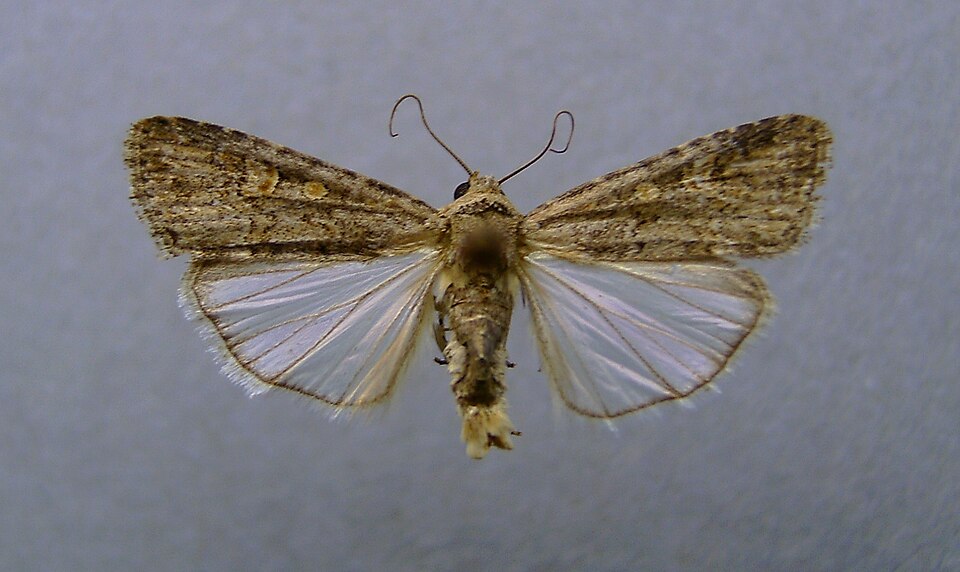
The beet armyworm is a small brown and grey moth. Its caterpillars are very hungry and eat lots of farm plants, so farmers know them well. They can munch a small plant until no leaves are left.
How big is it?
How wide are its wings?
How big is Beet armyworm compared to YOU?
Just maths in your browser. Nothing is saved or sent anywhere.
How fast is it?
Fun facts
Small caterpillars eat the soft middle of a leaf and leave only a thin see-through skin and the veins.
Bigger caterpillars bore holes straight into a head of lettuce.
As the young caterpillars crawl, they leave silk threads that cover leaves with a silvery film.
It cannot stand the cold, so in cold places it dies in winter and new moths fly back in spring.
It reached North America around 1876, when it was found in Oregon.
Most asked questions about Beet armyworm
?What does a beet armyworm eat?
Its caterpillars eat many crops, like beets, beans, lettuce, tomatoes and cotton.
?Is the beet armyworm dangerous?
Not to people. It only harms plants and crops.
?Why is it called armyworm?
Its caterpillars come in big numbers and eat their way through crops, like a marching army.
For bug experts
- Scientific name
- Spodoptera exigua
- Named by
- Hübner, 1808
- Group
- Moths
- Family
- Noctuidae
- Classification
- Insecta > Lepidoptera > Noctuidae
- Lives on
- Asia, Europe, North America, South America, Africa, Australia and Oceania
- Also known as
- Small mottled willow moth, Asparagus fern caterpillar
Where the facts come from
- Beet armyworm (Wikipedia, CC BY-SA 4.0): what it looks like, where it lives, what it eats, sizes and fun facts, retold in simple words.
- Picture by Dumi. CC BY-SA 3.0, Wikimedia Commons. The round sticker of this bug is cut from the same picture.
If we got something wrong, sorry, we are bug fans, not a science journal. Tell us at hello@bugwiki.app and we will fix it.
 Atlas moth
 Luna moth
 Hummingbird hawk-moth
 Domestic silk moth
 Isabella tiger moth
 Polyphemus moth
 Red-shouldered bug
 Big-headed ant
 Mediterranean fruit fly
 Asian citrus psyllid
 Chinch bug
 Metric paper wasp