

Mediterranean fruit fly
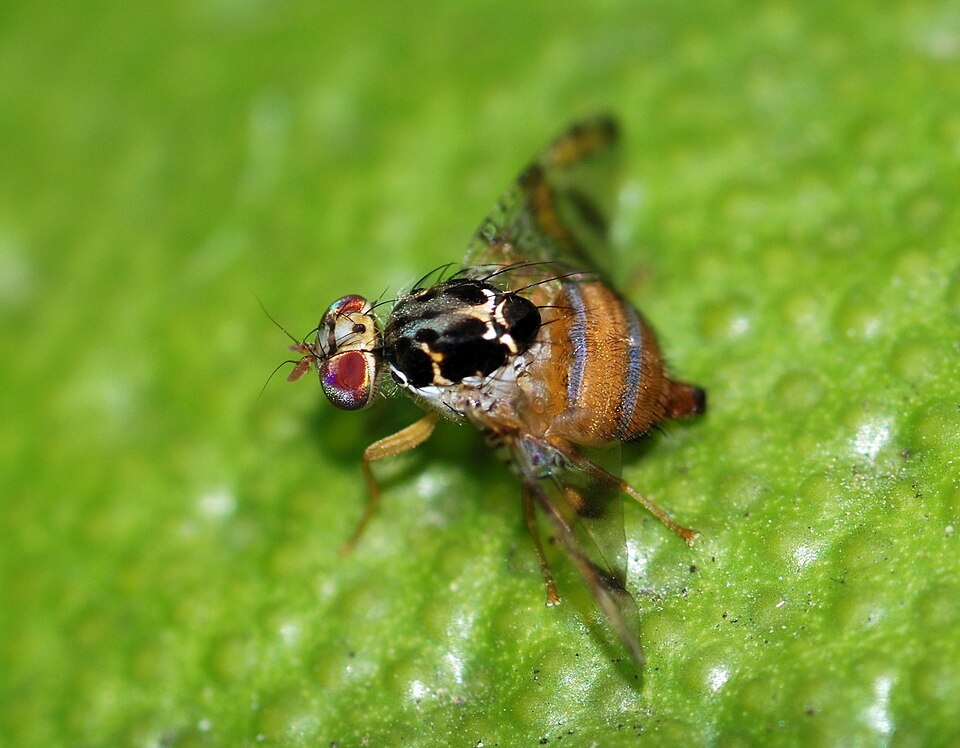
The Mediterranean fruit fly is a small yellow and brown fly with patterned wings. It lays its eggs inside fruit, and its babies eat the fruit from the inside. Farmers all over the world watch out for it.
How big is it?
How long is it?
How big is Mediterranean fruit fly compared to YOU?
Just maths in your browser. Nothing is saved or sent anywhere.
How fast is it?
Fun facts
The mother pokes her eggs just under the skin of a fruit, about 10 to 14 at a time.
The eggs hatch after only a few days, and the little maggots start eating the fruit from the inside.
When it is warm, it grows from egg to adult in just 3 weeks. When it is cool, it can take more than 3 months.
Males have shorter, wider wings than females, which helps them buzz louder to attract a mate.
It can fly about 20 kilometres to find fruit, but if there is enough fruit nearby, it stays close.
Most asked questions about Mediterranean fruit fly
?Is the Mediterranean fruit fly dangerous?
Not to people. It does not bite or sting, but it can spoil a lot of fruit.
?Why is the medfly a pest?
Its maggots eat the inside of more than 200 kinds of fruit and vegetables, so farmers lose a lot of their harvest.
?How big is a medfly?
It is tiny, only 3 to 5 millimetres long, smaller than a house fly.
For bug experts
- Scientific name
- Ceratitis capitata
- Group
- Flies and mosquitoes
- Family
- Tephritidae
- Classification
- Insecta > Diptera > Tephritidae
- Lives on
- Africa, Europe, Asia, North America, South America
- Also known as
- Medfly
Where the facts come from
- Ceratitis capitata (Wikipedia, CC BY-SA 4.0): what it looks like, where it lives, what it eats, sizes and fun facts, retold in simple words.
- Picture by Alvesgaspar ( talk ). CC BY-SA 3.0, Wikimedia Commons. The round sticker of this bug is cut from the same picture.
If we got something wrong, sorry, we are bug fans, not a science journal. Tell us at hello@bugwiki.app and we will fix it.
 Housefly
 New World screwworm fly
 Lovebug
 Tsetse fly
 Common fruit fly
 Asian tiger mosquito
 Eastern yellowjacket
 Virginian tiger moth
 Large yellow underwing
 White-marked tussock moth
 Northern black widow
 Golden tortoise beetle