

Blue orchard bee
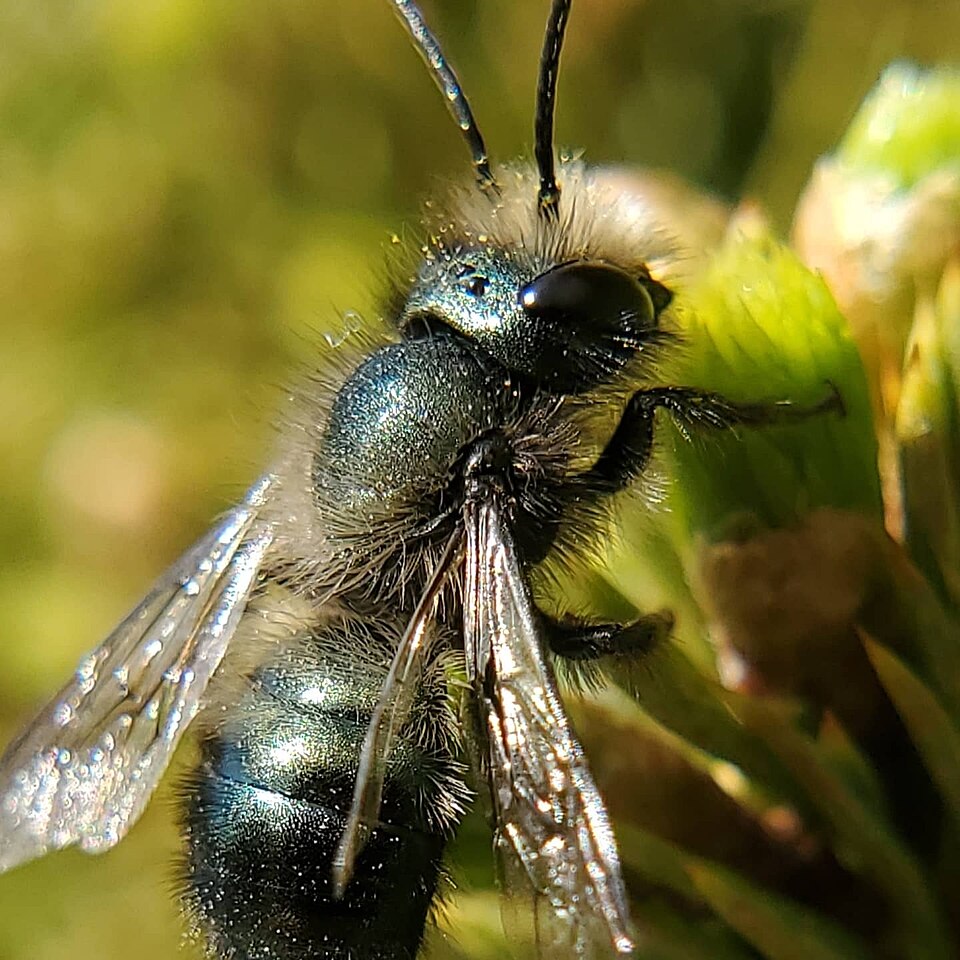
The blue orchard bee is a small bee from North America that works hard in fruit orchards every spring. It does not live in a hive. Each mother bee builds her own nest in a narrow hole and makes little rooms for her babies with walls of mud.
How fast is it?
Fun facts
It cannot drill into wood. It looks for holes that are already there, like hollow reeds, cracks and once even a keyhole.
On one trip it can visit about 75 flowers, and it needs about 25 trips to fill one baby room with food.
The mother bee chooses: girl eggs go at the back of the tunnel and boy eggs near the front.
Farmers put out paper tubes and wooden blocks so these bees nest close to their fruit trees and help the fruit grow.
In the morning it sunbathes until it is warm enough to fly.
Most asked questions about Blue orchard bee
?Does the blue orchard bee make honey?
No. It collects pollen and nectar only as food for its own babies, not to store as honey.
?Why is it called a mason bee?
Because it builds walls of mud inside its nest, like a little builder.
For bug experts
- Scientific name
- Osmia lignaria
- Group
- Bees and bumblebees
- Family
- Megachilidae
- Classification
- Insecta > Hymenoptera > Megachilidae
- Lives on
- North America
- Also known as
- Orchard mason bee
Where the facts come from
- Osmia lignaria (Wikipedia, CC BY-SA 4.0): what it looks like, where it lives, what it eats, sizes and fun facts, retold in simple words.
- Picture by (c) Doug Wolfe, some rights reserved (CC BY). CC BY 4.0, Wikimedia Commons. The round sticker of this bug is cut from the same picture.
If we got something wrong, sorry, we are bug fans, not a science journal. Tell us at hello@bugwiki.app and we will fix it.
 Western honey bee
 Buff-tailed bumblebee
 Violet carpenter bee
 Giant honey bee
 Wallace's giant bee
 Himalayan giant honey bee
 Barbary harvester ant
 Sycamore lace bug
 Small heath
 Copper underwing
 Mydas fly
 Cream-spot ladybird