

Blue-winged grasshopper
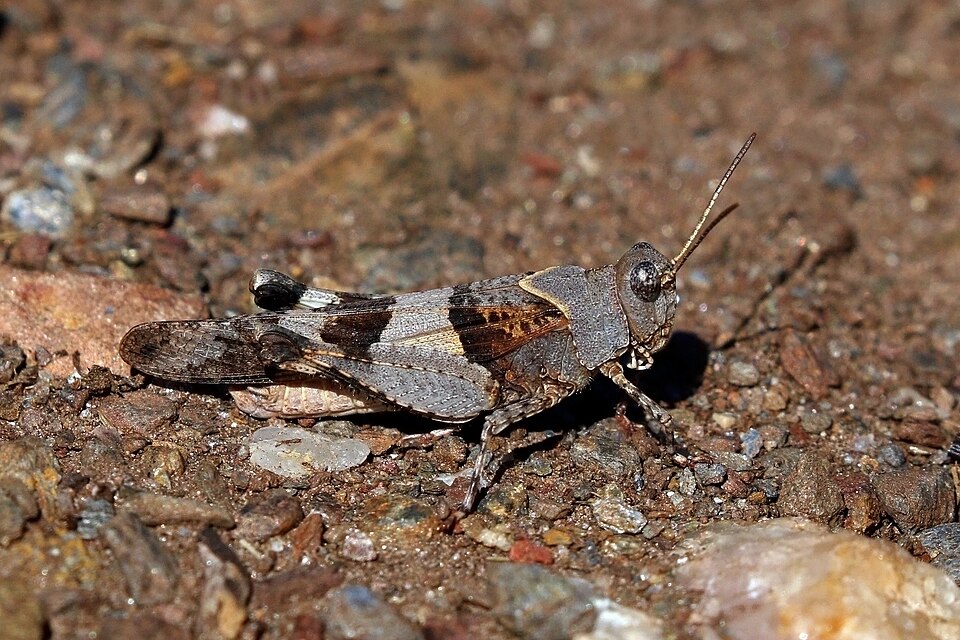
The blue-winged grasshopper has a secret. Sitting still, it is grey or brown and almost invisible on the ground. But when it jumps and flies, it flashes bright turquoise back wings with a black edge, like a little surprise.
How big is it?
How long is it?
How big is Blue-winged grasshopper compared to YOU?
Just maths in your browser. Nothing is saved or sent anywhere.
How fast is it?
Fun facts
Its body colour matches the ground where it grew up: reddish, grey, yellowish, dark or light.
It presses itself flat on the ground and stays still, and only jumps when danger is very close.
When it lands, it swings around to face where it came from. The blue suddenly vanishes, and hunters lose track of it.
It likes quarries, sand dunes, sunny rocks and even the stones beside railway tracks.
Unlike many grasshoppers, it hardly makes any sound at all.
Most asked questions about Blue-winged grasshopper
?Why does the blue-winged grasshopper have blue wings?
The blue flash surprises hunters, and when it lands and hides the blue, they cannot find it again.
?How big is the blue-winged grasshopper?
Boys are about 15 to 21 millimetres long and girls about 22 to 28 millimetres.
?Where does the blue-winged grasshopper live?
In dry, sunny, open places in Europe, North Africa and Asia.
For bug experts
- Scientific name
- Oedipoda caerulescens
- Named by
- Linnaeus, 1758
- Group
- Grasshoppers and crickets
- Family
- Acrididae
- Classification
- Insecta > Orthoptera > Acrididae
- Lives on
- Europe, Africa, Asia
Where the facts come from
- Oedipoda caerulescens (Wikipedia, CC BY-SA 4.0): what it looks like, where it lives, what it eats, sizes and fun facts, retold in simple words.
- Picture by Charles J. Sharp. CC BY-SA 4.0, Wikimedia Commons. The round sticker of this bug is cut from the same picture.
If we got something wrong, sorry, we are bug fans, not a science journal. Tell us at hello@bugwiki.app and we will fix it.
 Desert locust
 House cricket
 Parktown prawn
 Eastern lubber grasshopper
 Australian plague locust
 Mormon cricket
 Nine-spotted moth
 Desert woodlouse
 Desert millipede
 Cathedral termite
 Suffolk antlion
 Large-clawed scorpion
_male.jpg)