

Suffolk antlion
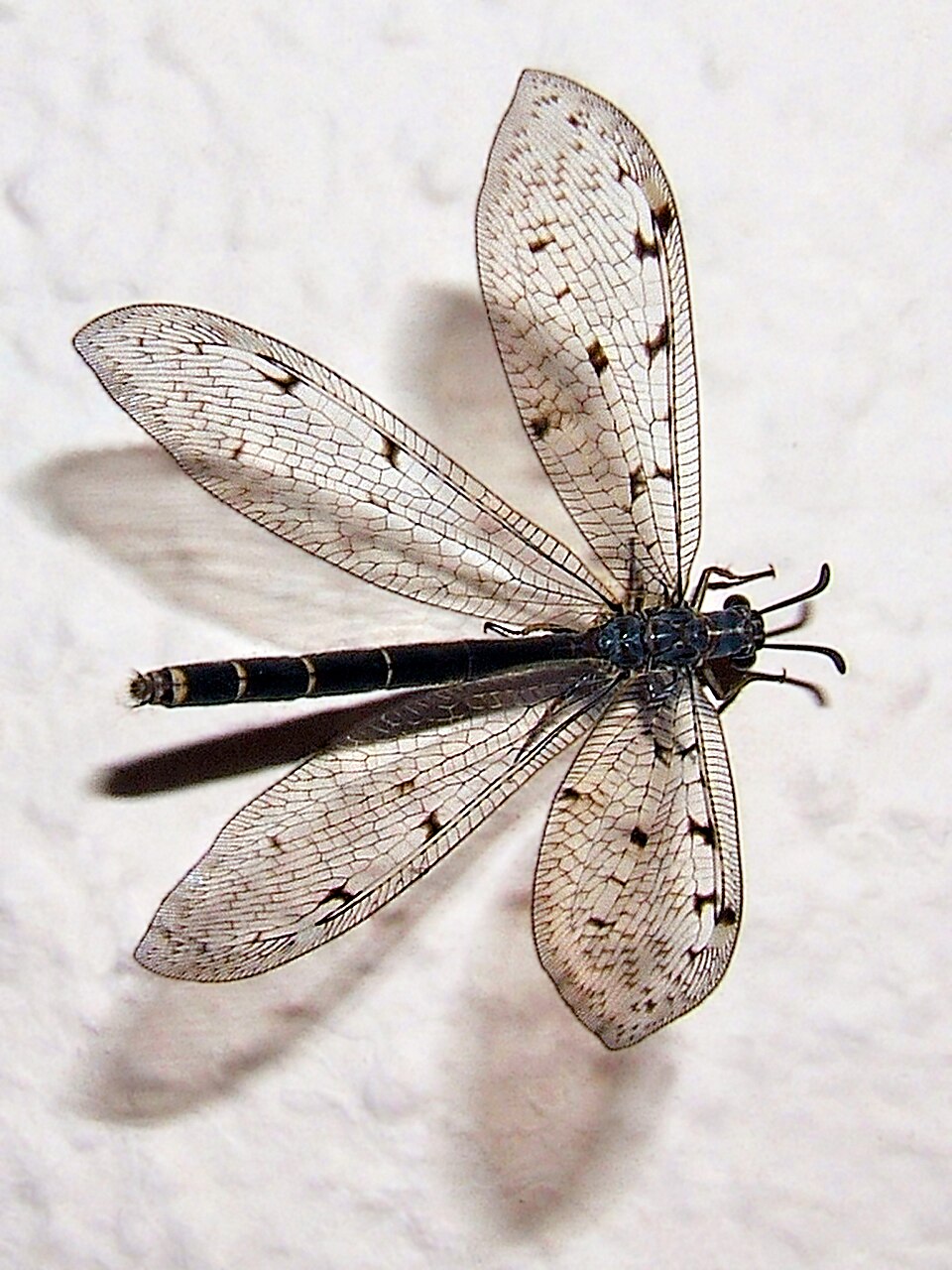
The Suffolk antlion starts life as a little hunter in the sand. Its baby digs a funnel-shaped pit and hides at the bottom with only its big jaws sticking out. The grown-up looks like a brown dragonfly with spotty wings.
How big is it?
How long is it?
How wide are its wings?
How big is Suffolk antlion compared to YOU?
Just maths in your browser. Nothing is saved or sent anywhere.
How fast is it?
Fun facts
The larva feels tiny shakes in the sand when an ant walks by. Then it flicks sand at the ant so it slides down into the pit.
The larva likes dry sand under a rock overhang, where the rain cannot reach its pit.
Growing up takes about two years. Then it hides under the sand and comes out a month later with four wings.
The grown-ups fly at night and hide in plants during the day, so people rarely see them.
In Britain it is very rare and lives in just a couple of places on the coast.
Most asked questions about Suffolk antlion
?What is an antlion?
It is an insect whose larva digs a little sand pit to trap ants. The grown-up has four long wings and looks a bit like a dragonfly.
?Can an antlion hurt you?
No. It is harmless to people. Its jaws are only for catching tiny animals.
?How big is the Suffolk antlion?
The grown-up is about 3 centimetres long, and its wings are about 7 centimetres across.
For bug experts
- Scientific name
- Euroleon nostras
- Group
- Other insects
- Family
- Myrmeleontidae
- Classification
- Insecta > Neuroptera > Myrmeleontidae
- Lives on
- Europe, Africa, Asia
Where the facts come from
- Euroleon nostras (Wikipedia, CC BY-SA 4.0): what it looks like, where it lives, what it eats, sizes and fun facts, retold in simple words.
- Picture by Wildfeuer. CC BY-SA 3.0, Wikimedia Commons. The round sticker of this bug is cut from the same picture.
If we got something wrong, sorry, we are bug fans, not a science journal. Tell us at hello@bugwiki.app and we will fix it.
 Common earwig
 Silverfish
 Chigoe flea
 Giant earwig
 Grannom
 Firebrat
 Greenbottle blue tarantula
 Dawson's burrowing bee
 Socotra Island blue baboon tarantula
 Red harvester ant
 Yellow fat-tailed scorpion
 Desertas wolf spider