

Bluebottle
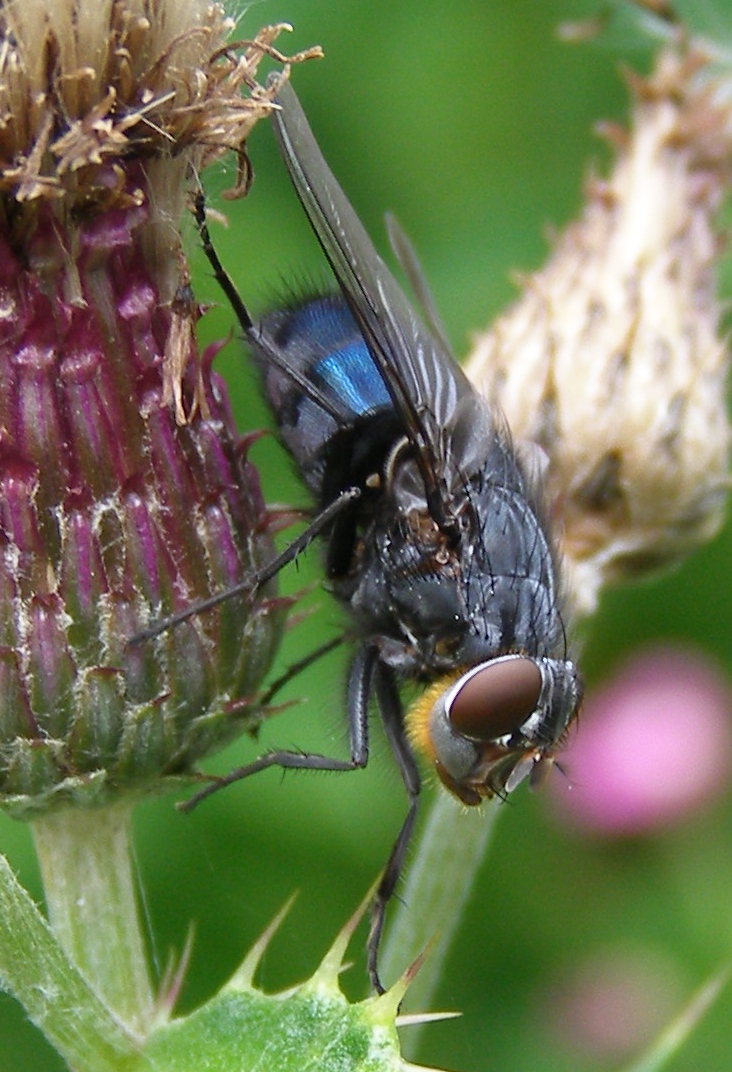
The bluebottle is a big, buzzy fly with a shiny metallic blue tail end. It is almost twice as big as a house fly. Look closely and you can see red eyes and orange hairs on its cheeks, like a little orange beard.
How big is it?
How long is it?
How big is Bluebottle compared to YOU?
Just maths in your browser. Nothing is saved or sent anywhere.
How fast is it?
Fun facts
Scientists can look at bluebottle maggots to work out how long ago an animal died. This helps detectives solve mysteries.
The orange hairs under its eyes help tell it apart from its close cousins.
A grown-up bluebottle usually lives for only 10 to 14 days.
In cold weather it can rest as a pupa and wait for warm days to come back.
Its maggots crawl away to a dry place and turn inside a tough brown case before they become flies.
Most asked questions about Bluebottle
?Is a bluebottle fly dangerous?
No, it cannot bite or sting. It is just good to keep it away from your food.
?How big is a bluebottle?
About 1 to 1.4 centimetres long, almost twice as big as a house fly.
?What do bluebottles eat?
The grown-ups drink nectar, and the maggots eat dead animals and rotting food.
For bug experts
- Scientific name
- Calliphora vomitoria
- Named by
- Linnaeus, 1758
- Group
- Flies and mosquitoes
- Family
- Calliphoridae
- Classification
- Insecta > Diptera > Calliphoridae
- Lives on
- Europe, North America, Africa
- Also known as
- Bluebottle fly, Orange-bearded bluebottle, Bottlebee
Where the facts come from
- Calliphora vomitoria (Wikipedia, CC BY-SA 4.0): what it looks like, where it lives, what it eats, sizes and fun facts, retold in simple words.
- Picture by TristramBrelstaff. CC BY-SA 4.0, Wikimedia Commons. The round sticker of this bug is cut from the same picture.
If we got something wrong, sorry, we are bug fans, not a science journal. Tell us at hello@bugwiki.app and we will fix it.
 Housefly
 New World screwworm fly
 Lovebug
 Tsetse fly
 Common fruit fly
 Asian tiger mosquito
 Australian house centipede
 Pig louse
 House centipede
 Domestic silk moth
 American cockroach
 Mealworm beetle