

Lovebug
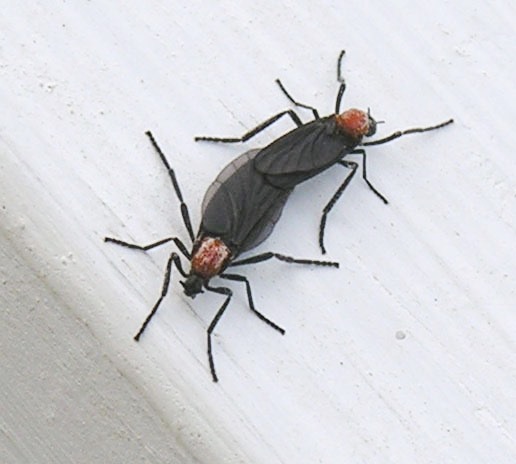
The lovebug is a small black fly with a red-orange back. It got its name because a male and a female fly around joined together, tail to tail, sometimes for days. In spring and late summer, huge swarms of them fill the air near roads.
How fast is it?
Fun facts
A female lives only three or four days, and the males live a little longer.
Swarms of lovebugs have been seen flying 300 to 450 metres up in the sky.
They are drawn to light-coloured things, especially fresh paint.
Squashed lovebugs on a car turn slightly sour and become very hard to wash off.
A female can lay up to 350 eggs in rotting plants on the ground.
Most asked questions about Lovebug
?Do lovebugs bite?
No. Lovebugs cannot bite or sting, and they do not spread disease.
?Why do lovebugs fly stuck together?
A male and a female stay joined after mating and fly around together, sometimes for several days.
?What do lovebugs eat?
The grown-ups drink nectar from flowers. The larvae eat rotting plants in the grass.
Myth buster
Myth: Scientists made lovebugs in a lab to get rid of mosquitoes.
Truth: No. Lovebugs reached Florida on their own, spreading along the coast of the Gulf of Mexico.
For bug experts
- Scientific name
- Plecia nearctica
- Named by
- Hardy, 1940
- Group
- Flies and mosquitoes
- Family
- Bibionidae
- Classification
- Insecta > Diptera > Bibionidae
- Lives on
- North America
- Also known as
- Honeymoon fly, Double-headed bug
Where the facts come from
- Lovebug (Wikipedia, CC BY-SA 4.0): what it looks like, where it lives, what it eats, sizes and fun facts, retold in simple words.
- Picture by No machine-readable author provided. Wikifrosch~commonswiki assumed (based on copyright claims).. CC BY-SA 3.0, Wikimedia Commons. The round sticker of this bug is cut from the same picture.
If we got something wrong, sorry, we are bug fans, not a science journal. Tell us at hello@bugwiki.app and we will fix it.
 Housefly
 New World screwworm fly
 Tsetse fly
 Common fruit fly
 Asian tiger mosquito
 Yellow fever mosquito
 Alfalfa leafcutter bee
 Rainbow grasshopper
 Common green grasshopper
 Tree wasp
 Citrus longhorn beetle
 Blue pansy