

Broad-bodied chaser
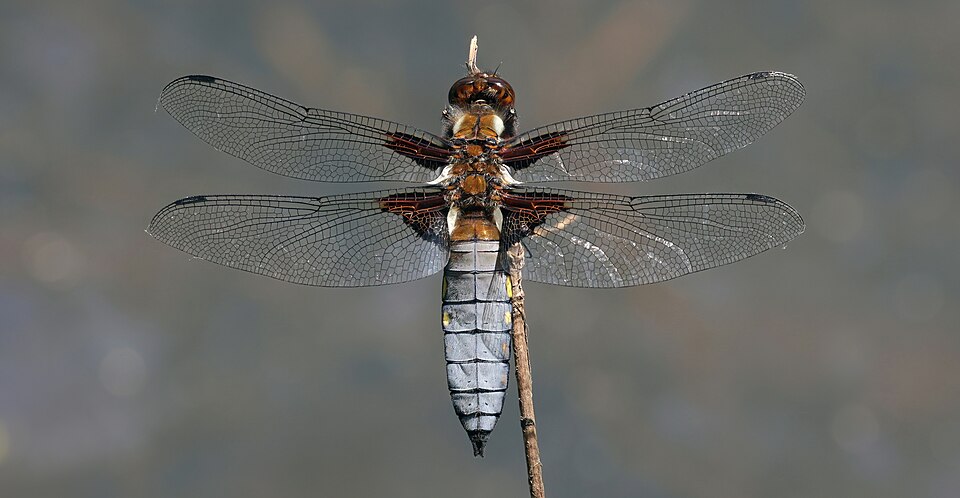
The broad-bodied chaser is a dragonfly with a short, wide, flat body. Males have a powdery blue body, and females are brown with yellow patches on the sides. Each wing has a dark patch where it joins the body.
How big is it?
How long is it?
How wide are its wings?
How big is Broad-bodied chaser compared to YOU?
Just maths in your browser. Nothing is saved or sent anywhere.
How fast is it?
Fun facts
It is often the very first dragonfly to move into a brand new pond.
Males are very bossy and fight rival males and any other dragonfly that comes by.
It likes to come back to the same sunny perch again and again.
The mother hovers over the water and dips the tip of her tail in to lay her eggs.
Its babies hide buried in the mud at the bottom of the pond, with only their head and eyes peeking out.
Most asked questions about Broad-bodied chaser
?Why is the broad-bodied chaser blue?
Only the males are blue. A powdery blue coat grows over their brown body as they grow up.
?Is the broad-bodied chaser dangerous?
No. Dragonflies cannot sting and are harmless to people.
?How big is the broad-bodied chaser?
It is about 4 to 5 centimetres long, with wings about 7 centimetres across.
For bug experts
- Scientific name
- Libellula depressa
- Named by
- Linnaeus, 1758
- Group
- Dragonflies and damselflies
- Family
- Libellulidae
- Classification
- Insecta > Odonata > Libellulidae
- Lives on
- Europe, Asia
Where the facts come from
- Libellula depressa (Wikipedia, CC BY-SA 4.0): what it looks like, where it lives, what it eats, sizes and fun facts, retold in simple words.
- Picture by Charles J. Sharp. CC BY-SA 4.0, Wikimedia Commons. The round sticker of this bug is cut from the same picture.
If we got something wrong, sorry, we are bug fans, not a science journal. Tell us at hello@bugwiki.app and we will fix it.
 Emperor dragonfly
 Common whitetail
 Green darner
 Ebony jewelwing
 Globe skimmer
 Blue dasher
 Lesser water boatman
 Palamedes swallowtail
 Katipō
 Bladder snail
 North American medicinal leech
 Giant isopod
_male_dorsal_side.jpg)