

Cassin's periodical cicada
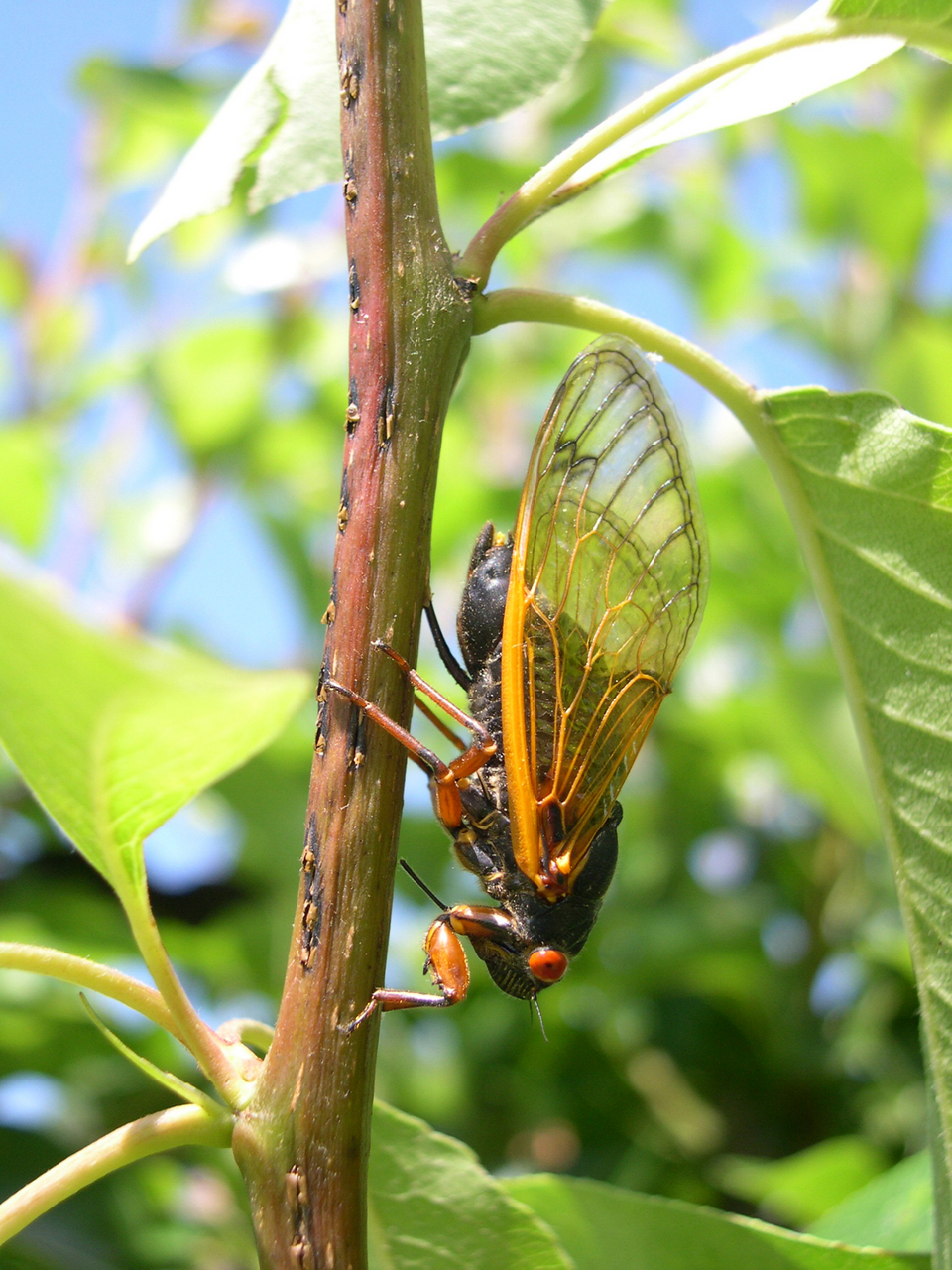
Cassin's periodical cicada has a black body, orange legs and big red eyes. It spends 17 whole years underground as a baby. Then, all at the same time, thousands and thousands of them dig up into the open air and start to sing.
How big is it?
How long is it?
How big is Cassin's periodical cicada compared to YOU?
Just maths in your browser. Nothing is saved or sent anywhere.
How fast is it?
Fun facts
The boy cicadas can sing and fly all together at the same moment, tens of thousands of them, like a huge choir.
Its song is a row of ticks followed by a long buzz that goes up and down.
The root sap the babies drink is not very filling, so they grow very slowly.
The baby sheds its skin five times underground before it climbs up a plant and becomes a winged cicada.
Blue-eyed cicadas really exist, but only about one in a million has them.
Most asked questions about Cassin's periodical cicada
?How long do 17-year cicadas live underground?
About 17 years. Some groups come up a bit earlier or later, between 13 and 21 years.
?Do cicadas bite or sting?
No. They are harmless to people, they only suck sap from plants.
?Why do cicadas make so much noise?
The boys sing together in big groups to attract the girls.
Myth buster
Myth: If you catch a blue-eyed cicada, a laboratory will pay you a million dollars.
Truth: That is just a story. Blue-eyed cicadas are very rare, but no laboratory pays a reward like that for them.
For bug experts
- Scientific name
- Magicicada cassini
- Named by
- Fisher, 1852
- Group
- True bugs and cicadas
- Family
- Cicadidae
- Classification
- Insecta > Hemiptera > Cicadidae
- Lives on
- North America
- Also known as
- 17-year cicada, Dwarf periodical cicada
Where the facts come from
- Magicicada cassini (Wikipedia, CC BY-SA 4.0): what it looks like, where it lives, what it eats, sizes and fun facts, retold in simple words.
- Picture by Fontaine K, Cooley J, Simon C (2007). CC BY 2.5, Wikimedia Commons. The round sticker of this bug is cut from the same picture.
If we got something wrong, sorry, we are bug fans, not a science journal. Tell us at hello@bugwiki.app and we will fix it.
 Pharaoh cicada
 Spotted lanternfly
 Brown marmorated stink bug
 Cochineal
 Boxelder bug
 Western conifer seed bug
 Dark bush-cricket
 Black firefly
 Forest cockchafer
 Wellington tree wētā
 Common sexton beetle
 Kaiser-i-Hind