

Colorado potato beetle
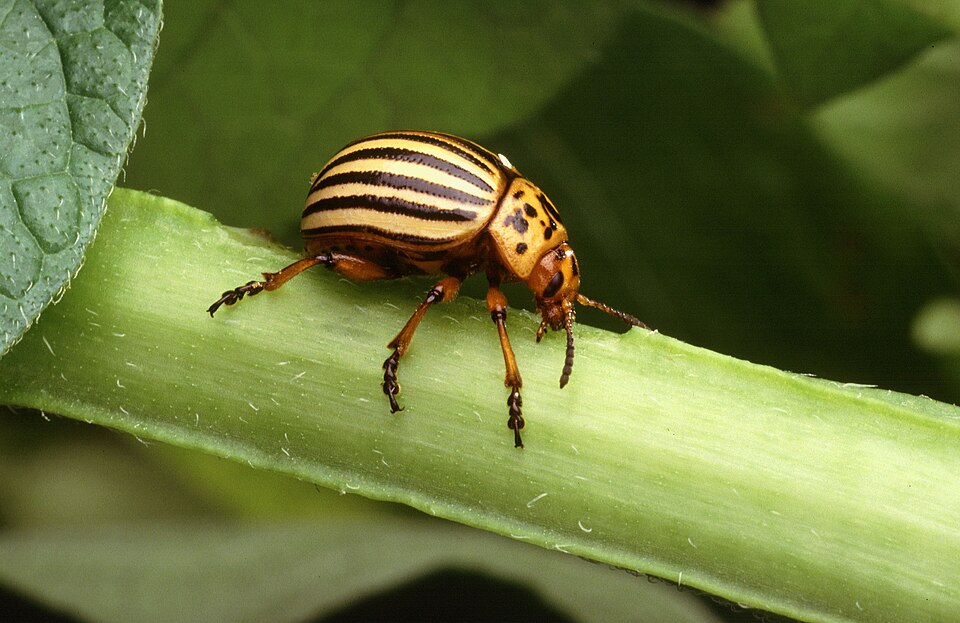
The Colorado potato beetle is a small, round beetle with a yellow-orange back and ten black stripes. It loves potato plants more than anything. Farmers are not fond of it, because it and its babies can eat a whole potato field bare.
How big is it?
How long is it?
How big is Colorado potato beetle compared to YOU?
Just maths in your browser. Nothing is saved or sent anywhere.
How fast is it?
Fun facts
When it found potato fields, it spread across America at about 140 kilometres a year.
One female can lay more than 500 eggs in about a month.
Its larvae are orange-pink with a black head and grow up to 1.5 centimetres long.
It has reached Britain many times, and people there have cleared it away more than 160 times.
Before potato fields existed nearby, it lived in the Rocky Mountains eating a wild plant called buffalo bur.
Most asked questions about Colorado potato beetle
?Is the Colorado potato beetle dangerous?
Not to people. It is harmless to touch, but it is a big problem for potato plants.
?What does the Colorado potato beetle eat?
Mostly potato leaves. The larvae eat them too.
?How big is a Colorado potato beetle?
About 6 to 11 millimetres long, about the size of a fingernail.
Myth buster
Myth: Colorado potato beetles were dropped on Europe from planes.
Truth: No. That was a made-up story. The beetles reached Europe from America with ships and goods and then spread by themselves.
For bug experts
- Scientific name
- Leptinotarsa decemlineata
- Named by
- Say, 1824
- Group
- Beetles
- Family
- Chrysomelidae
- Classification
- Insecta > Coleoptera > Chrysomelidae
- Lives on
- North America, Europe, Asia
- Also known as
- Colorado beetle, Ten-striped spearman, Ten-lined potato beetle, Potato bug
Where the facts come from
- Colorado potato beetle (Wikipedia, CC BY-SA 4.0): what it looks like, where it lives, what it eats, sizes and fun facts, retold in simple words.
- Picture by Scott Bauer, USDA ARS. Public domain, Wikimedia Commons. The round sticker of this bug is cut from the same picture.
If we got something wrong, sorry, we are bug fans, not a science journal. Tell us at hello@bugwiki.app and we will fix it.
 Stag beetle
 Hercules beetle
 Common glow-worm
 Goliath beetle
 Cockchafer
 Mealworm beetle
 Labyrinth spider
 American lady
 Adonis blue
 Four-spot orb-weaver
 Common rose
 Ashy mining bee