

Common green bottle fly
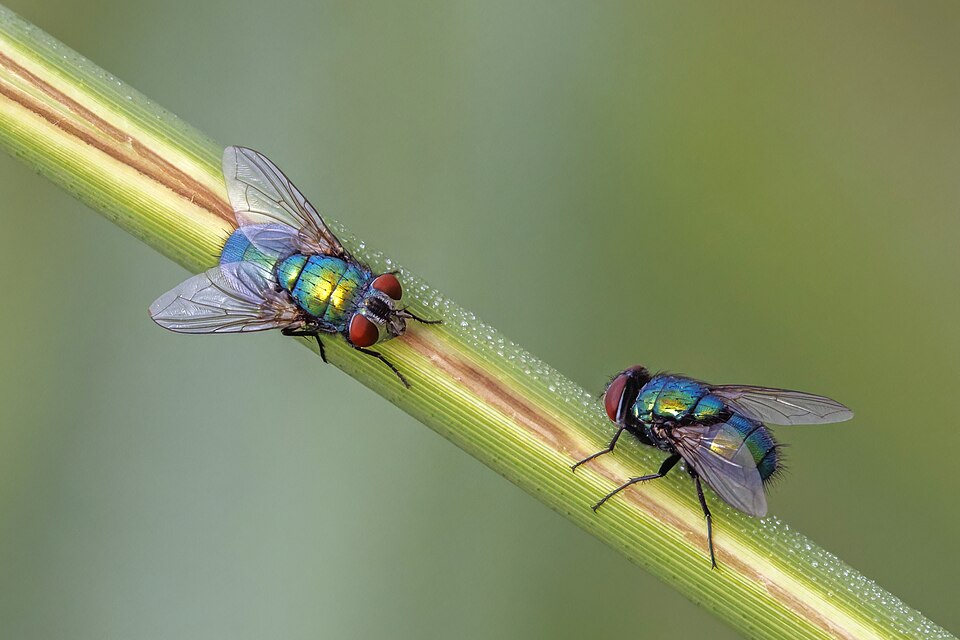
The common green bottle fly is a shiny fly that glitters metallic green, blue or gold, like a jewel. It is a bit bigger than a house fly. It is one of nature's clean-up crew, because its babies eat dead animals.
How big is it?
How long is it?
How big is Common green bottle fly compared to YOU?
Just maths in your browser. Nothing is saved or sent anywhere.
How fast is it?
Fun facts
Doctors sometimes use its clean, specially raised maggots to clean wounds that will not heal.
Scientists who solve crimes study its maggots to work out how long ago an animal died.
One female can lay 2,000 to 3,000 eggs in her life.
Its eggs can hatch in as little as nine hours when it is warm.
The grown-up flies visit flowers and help pollinate them.
Most asked questions about Common green bottle fly
?Does the green bottle fly bite?
No. It cannot bite or sting people.
?What do green bottle flies eat?
Their maggots eat dead animals. Adults eat rotting things too, plus nectar and pollen from flowers.
?How big is a green bottle fly?
About 10 to 14 millimetres long, a little bigger than a house fly.
For bug experts
- Scientific name
- Lucilia sericata
- Group
- Flies and mosquitoes
- Family
- Calliphoridae
- Classification
- Insecta > Diptera > Calliphoridae
- Lives on
- Europe, Africa, Asia, Australia and Oceania, North America, South America
Where the facts come from
- Common green bottle fly (Wikipedia, CC BY-SA 4.0): what it looks like, where it lives, what it eats, sizes and fun facts, retold in simple words.
- Picture by Charles J. Sharp. CC BY-SA 4.0, Wikimedia Commons. The round sticker of this bug is cut from the same picture.
If we got something wrong, sorry, we are bug fans, not a science journal. Tell us at hello@bugwiki.app and we will fix it.
 Housefly
 New World screwworm fly
 Lovebug
 Tsetse fly
 Common fruit fly
 Asian tiger mosquito
 Fencepost jumping spider
 Mexican bean beetle
 Duke of Burgundy
 Hairy-footed flower bee
 Fiery skipper
 Elm leaf beetle
_female_left_and_male_B%C3%BCrgerpark.jpg)