

Devil's coach horse
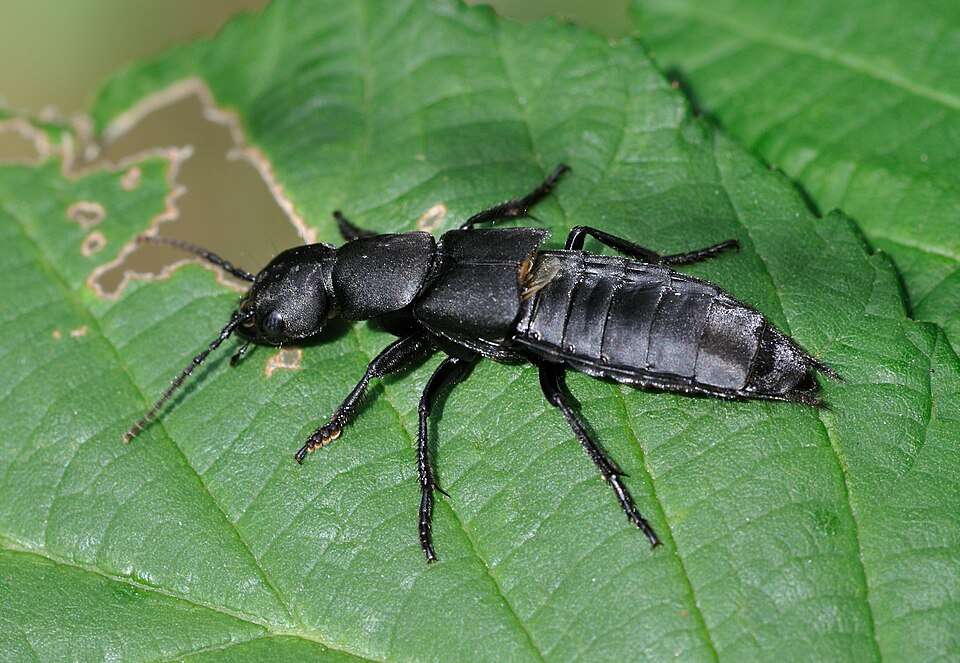
The devil's coach horse is a long, black beetle covered in fine hairs. Its wing cases are very short, so you can see its long, bendy back end. When it is scared, it lifts its tail and opens its jaws, a bit like a scorpion.
How big is it?
How long is it?
How big is Devil's coach horse compared to YOU?
Just maths in your browser. Nothing is saved or sent anywhere.
How fast is it?
Fun facts
It can fly, but it hardly ever uses its wings.
When it raises its tail it can also let out a stinky smell from two white spots at the end of its body.
During the day it hides under logs, stones and leaves.
Its eggs are big for a beetle, about 4 millimetres long, and laid one by one in damp places.
An old British story says this beetle ate the core of Eve's apple.
Most asked questions about Devil's coach horse
?Does the devil's coach horse sting?
No. It has no sting, even though it lifts its tail like a scorpion. But it can bite.
?How big is a devil's coach horse?
It is 20 to 32 millimetres long, one of the bigger beetles in Europe.
?What does a devil's coach horse eat?
It hunts worms, slugs, spiders and woodlice, and also eats dead animals.
Myth buster
Myth: The devil's coach horse can sting like a scorpion.
Truth: No. It has no sting at all. It only raises its tail to scare enemies, but it can bite.
For bug experts
- Scientific name
- Ocypus olens
- Named by
- Müller, 1764
- Group
- Beetles
- Family
- Staphylinidae
- Classification
- Insecta > Coleoptera > Staphylinidae
- Lives on
- Europe, Africa, North America
- Also known as
- Devil's footman, Devil's coachman, Devil's steed, Cock-tail beetle
Where the facts come from
- Devil's coach horse beetle (Wikipedia, CC BY-SA 4.0): what it looks like, where it lives, what it eats, sizes and fun facts, retold in simple words.
- Picture by Quartl. CC BY-SA 3.0, Wikimedia Commons. The round sticker of this bug is cut from the same picture.
If we got something wrong, sorry, we are bug fans, not a science journal. Tell us at hello@bugwiki.app and we will fix it.
 Stag beetle
 Hercules beetle
 Common glow-worm
 Goliath beetle
 Cockchafer
 Mealworm beetle
 Green hairstreak
 Grapeleaf skeletoniser
 Goldenrod gall fly
 Margined calligrapher
 Red-legged grasshopper
 Horse-chestnut leaf miner