

Flatid leaf bug
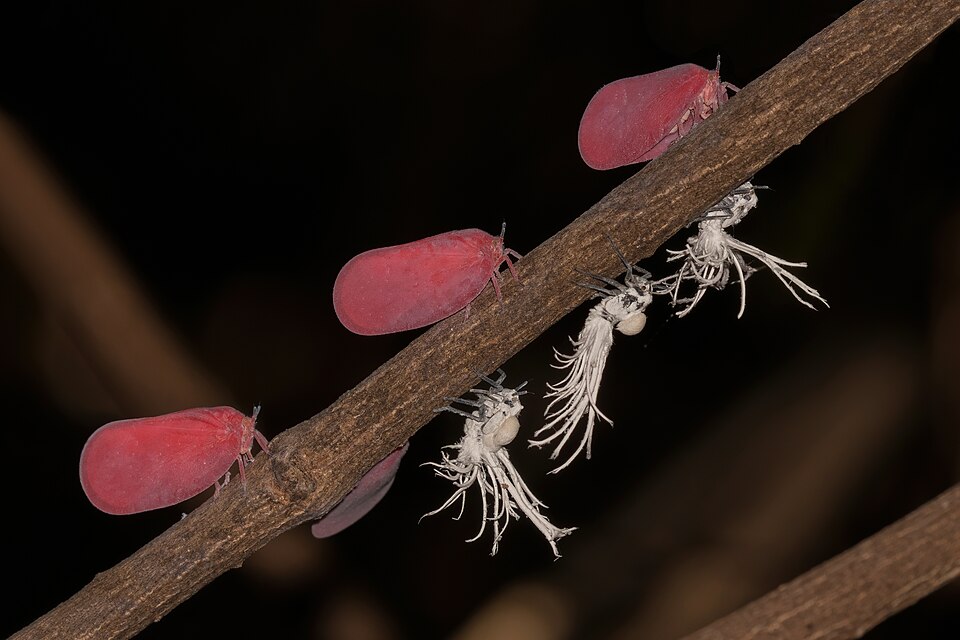
The flatid leaf bug is a little bug from Madagascar with wide pink wings that it holds up like a tent. Many of them sit together on a stem in a neat group. Together they look just like a pink flower spike.
How fast is it?
Fun facts
Its babies have no wings. Instead they are covered in fluffy white wax with a tail of waxy curls.
If you disturb a grown-up, it can jump away.
The babies make lots of sweet, sticky honeydew, and a bird called Coquerel's coua comes to eat it.
Pretending to be a flower may help keep it safe from hungry birds.
Most asked questions about Flatid leaf bug
?Why does the flatid leaf bug look like a flower?
Many of them sit together with their pink wings up, so the group looks like a flower spike.
?Where does the flatid leaf bug live?
In dry tropical forests in Madagascar.
?What does the flatid leaf bug eat?
It sucks sap from a climbing plant.
For bug experts
- Scientific name
- Phromnia rosea
- Group
- True bugs and cicadas
- Family
- Flatidae
- Classification
- Insecta > Hemiptera > Flatidae
- Lives on
- Africa
- Also known as
- Flower-spike bug
Where the facts come from
- Flatida rosea (Wikipedia, CC BY-SA 4.0): what it looks like, where it lives, what it eats, sizes and fun facts, retold in simple words.
- Picture by Charles J. Sharp. CC BY-SA 4.0, Wikimedia Commons. The round sticker of this bug is cut from the same picture.
If we got something wrong, sorry, we are bug fans, not a science journal. Tell us at hello@bugwiki.app and we will fix it.
 Pharaoh cicada
 Spotted lanternfly
 Brown marmorated stink bug
 Cochineal
 Boxelder bug
 Western conifer seed bug
 Emerald swallowtail
 Harlequin beetle
 Kauai cave wolf spider
 Great Mormon
 Giant rainforest mantis
 Paper kite butterfly
.jpg)