

Garden bumblebee
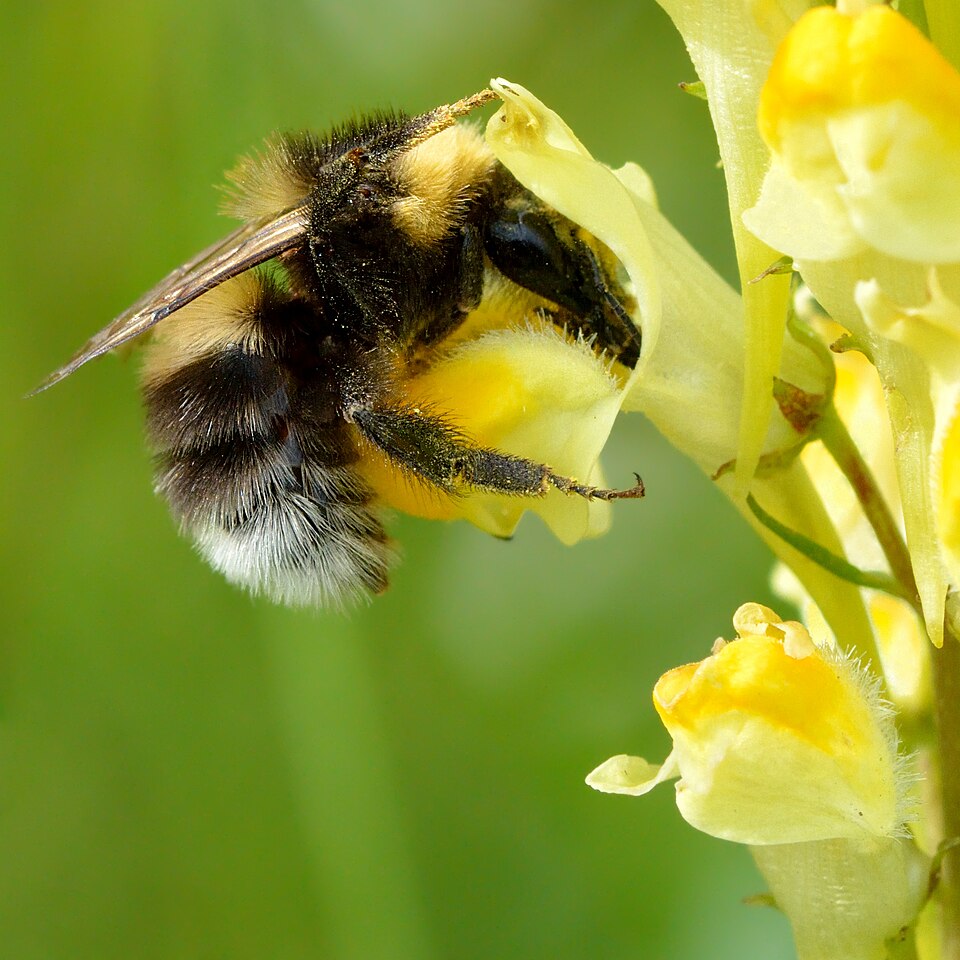
The garden bumblebee is a black bumblebee with three yellow bands and a white tail. It has a super long tongue, so long that it often flies with it sticking out. With it, it can reach the nectar deep inside long flowers.
How fast is it?
Fun facts
Its tongue is about 15 millimetres long, sometimes even 20, nearly as long as its body.
The queen is 19 to 22 millimetres long, and the workers are almost as big.
It has a good memory for places, which helps it find its way back to the best flowers.
People took it to New Zealand in 1885, and it still lives there today.
It likes grassy fields where cows graze, because there are lots of different flowers there.
Most asked questions about Garden bumblebee
?Why does the garden bumblebee have such a long tongue?
To reach the nectar deep inside long, tube shaped flowers like foxglove.
?How can I recognise a garden bumblebee?
Look for a black bee with three yellow bands, a white tail and a long face.
For bug experts
- Scientific name
- Bombus hortorum
- Group
- Bees and bumblebees
- Family
- Apidae
- Classification
- Insecta > Hymenoptera > Apidae
- Lives on
- Europe, Asia, Australia and Oceania
- Also known as
- Small garden bumblebee
Where the facts come from
- Bombus hortorum (Wikipedia, CC BY-SA 4.0): what it looks like, where it lives, what it eats, sizes and fun facts, retold in simple words.
- Picture by Ivar Leidus. CC BY-SA 4.0, Wikimedia Commons. The round sticker of this bug is cut from the same picture.
If we got something wrong, sorry, we are bug fans, not a science journal. Tell us at hello@bugwiki.app and we will fix it.
 Western honey bee
 Buff-tailed bumblebee
 Violet carpenter bee
 Giant honey bee
 Wallace's giant bee
 Himalayan giant honey bee
 Snowberry clearwing
 Western tiger swallowtail
 Vapourer moth
 Common rough woodlouse
 Brown centipede
 Giant peacock moth