

Bug card No. 0601 of 1,500
Giant peacock moth
Saturnia pyri
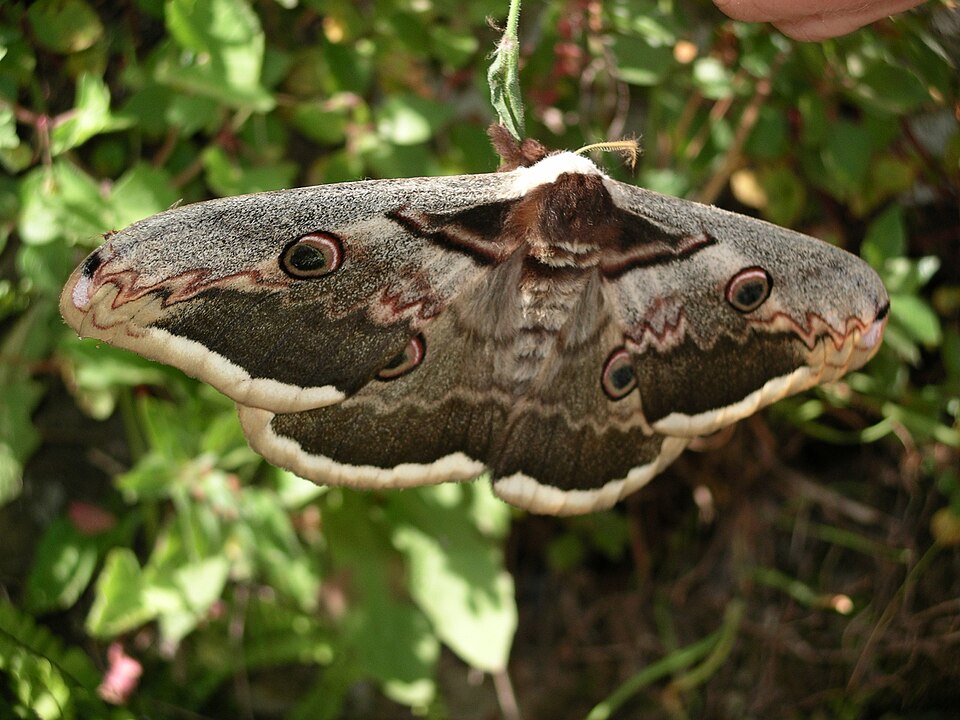
The giant peacock moth is the biggest moth in Europe. Its wings are so wide it could cover a grown-up's hand. Like a peacock, it has a big round eye spot on each wing.
Lives in
Southern and eastern Europe, Turkey and the Middle East, and on into Siberia and North Africa
Wingspan
15 to 20 cm (5.9 to 7.9 in)
Can it hurt you?
Harmless
Harmless. It cannot bite or sting.
What does it eat?
The grown-up moth does not eat at all and lives on the energy it stored up as a caterpillar.
How big is it?
How wide are its wings?
✋wings as wide as your hand⚽could fly across a whole football pitch in 12 seconds
How big is Giant peacock moth compared to YOU?
Just maths in your browser. Nothing is saved or sent anywhere.
How fast is it?
A kid running fast about 13 km/h (8.1 mph)
A grown-up on a bike about 25 km/h (16 mph)
Giant peacock moth about 31 km/h (19 mph)
A car driving in town about 50 km/h (31 mph)
cool stuff
Fun facts
1
Its wings can be 15 to 20 centimetres from tip to tip, wider than a big pancake.
2
It does not live in Britain. The few that were seen there had probably escaped from people who kept them.
3
Two scientists in Vienna first described it in 1775, which is why one of its names is the Viennese emperor.
you asked
Most asked questions about Giant peacock moth
?What is the biggest moth in Europe?
The giant peacock moth. Its wings can be 15 to 20 centimetres across.
?Is the giant peacock moth dangerous?
No. It is completely harmless.
For bug experts
- Scientific name
- Saturnia pyri
- Named by
- Denis & Schiffermüller, 1775
- Group
- Moths
- Family
- Saturniidae
- Classification
- Insecta > Lepidoptera > Saturniidae
- Lives on
- Europe, Asia, Africa
- Also known as
- Great peacock moth, Giant emperor moth, Viennese emperor
Where the facts come from
- Saturnia pyri (Wikipedia, CC BY-SA 4.0): what it looks like, where it lives, what it eats, sizes and fun facts, retold in simple words.
- Picture by Velela. Public domain, Wikimedia Commons. The round sticker of this bug is cut from the same picture.
If we got something wrong, sorry, we are bug fans, not a science journal. Tell us at hello@bugwiki.app and we will fix it.
 Atlas moth
 Luna moth
 Hummingbird hawk-moth
 Domestic silk moth
 Isabella tiger moth
 Polyphemus moth
 Nine-spotted ladybird
 Australian paper wasp
 Clouded sulphur
 Yellow-faced bumblebee
 Dimorphic jumper
 Pennsylvania grass spider