

Grey field slug
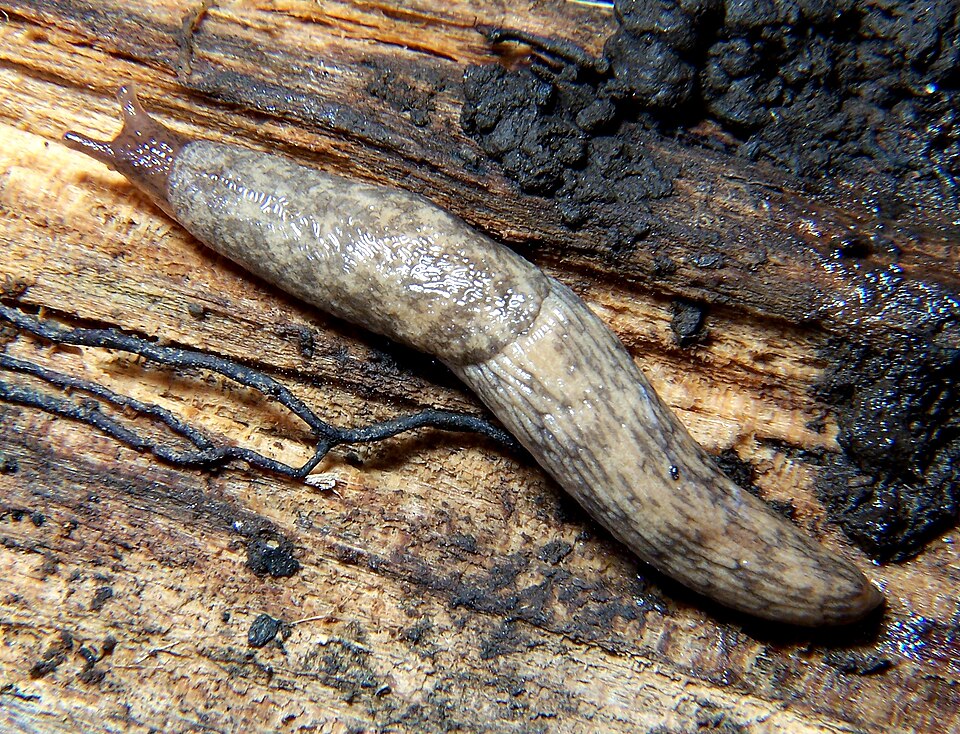
The grey field slug is a small creamy grey slug with a pattern of dark spots like a net on its back. It has no shell at all. It comes out at night to eat leaves in gardens and fields.
How big is it?
How long is it?
How big is Grey field slug compared to YOU?
Just maths in your browser. Nothing is saved or sent anywhere.
How fast is it?
Fun facts
Its slime is clear, but when the slug is bothered it turns milky white. That is why it is also called the milky slug.
In one night it can slide up to 12 metres.
During the day it hides under stones and old leaves.
It lays hundreds of eggs, and most slugs live for only about a year.
Ground beetles are its enemies and gobble up its eggs and babies.
Most asked questions about Grey field slug
?Is the grey field slug harmful?
Not to people. But it eats young plants, so it is a big pest for farmers and gardeners.
?How big is the grey field slug?
It can be about 4 to 6 cm long when it stretches out.
?What does the grey field slug eat?
Mostly fresh leaves, fruit and young seedlings.
For bug experts
- Scientific name
- Deroceras reticulatum
- Group
- Snails, slugs and worms
- Family
- Agriolimacidae
- Classification
- Gastropoda > Stylommatophora > Agriolimacidae
- Lives on
- Europe, Africa, North America, South America, Australia and Oceania, Asia
- Also known as
- Grey garden slug, Milky slug
Where the facts come from
- Deroceras reticulatum (Wikipedia, CC BY-SA 4.0): what it looks like, where it lives, what it eats, sizes and fun facts, retold in simple words.
- Picture by Bruce Marlin. CC BY-SA 3.0, Wikimedia Commons. The round sticker of this bug is cut from the same picture.
If we got something wrong, sorry, we are bug fans, not a science journal. Tell us at hello@bugwiki.app and we will fix it.
 Garden snail
 Giant African land snail
 Leopard slug
 Bladder snail
 Medicinal leech
 Common earthworm
 Brown-belted bumblebee
 Eyed hawk-moth
 Common grass yellow
 Swollen-thighed beetle
 Common striped woodlouse
 Ashy grey ladybird