

Harlequin ladybird
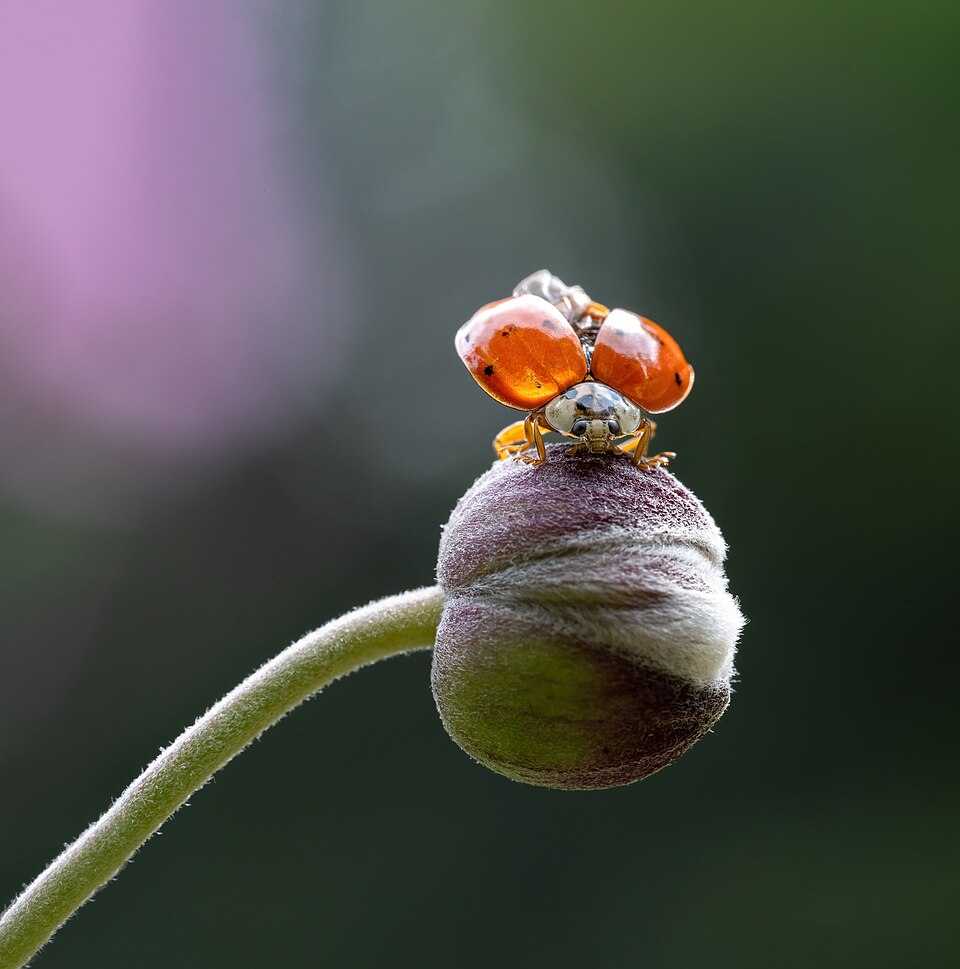
The harlequin ladybird is a big ladybird that comes in many different costumes. It can be orange or red with lots of black spots, or no spots at all, or black with two or four red spots. Like a harlequin clown, it is always dressed in a different pattern.
How big is it?
How long is it?
How big is Harlequin ladybird compared to YOU?
Just maths in your browser. Nothing is saved or sent anywhere.
How fast is it?
Fun facts
It can have anywhere from zero to 22 black spots.
People brought it to North America and Europe on purpose, to eat the aphids on farms and in greenhouses.
In North America it is called the Halloween beetle, because in October it flies into houses to spend the winter.
Its legs are always reddish-brown, which helps you tell it apart from other ladybirds.
Its little yellow eggs turn black one day before they hatch.
Most asked questions about Harlequin ladybird
?Is the harlequin ladybird dangerous?
No. It does not sting and cannot really hurt you.
?How can you tell a harlequin ladybird?
It is bigger than most ladybirds, has reddish-brown legs and often a white patch with a black M shape behind its head.
?What does the harlequin ladybird eat?
Mostly aphids and scale insects, the tiny bugs that suck on plants.
Myth buster
Myth: The harlequin ladybird is not a real ladybird.
Truth: It is. It is a true ladybird, just a different kind from the ones that have always lived in Europe.
For bug experts
- Scientific name
- Harmonia axyridis
- Group
- Ladybirds
- Family
- Coccinellidae
- Classification
- Insecta > Coleoptera > Coccinellidae
- Lives on
- Asia, North America, South America, Europe, Africa, Australia and Oceania
- Also known as
- Asian lady beetle, Multicoloured Asian lady beetle, Halloween beetle, Pumpkin ladybird
Where the facts come from
- Harmonia axyridis (Wikipedia, CC BY-SA 4.0): what it looks like, where it lives, what it eats, sizes and fun facts, retold in simple words.
- Picture by Wilfredor. CC0, Wikimedia Commons. The round sticker of this bug is cut from the same picture.
If we got something wrong, sorry, we are bug fans, not a science journal. Tell us at hello@bugwiki.app and we will fix it.
 Seven-spot ladybird
 Mealybug destroyer
 Twenty-two-spot ladybird
 Twice-stabbed ladybird
 Spotted pink ladybird
 Steelblue ladybird
 Fiery searcher
 Long-tailed blue
 Lined click beetle
 Wall brown
 Spotted wolf spider
 Median wasp