

Hessian fly
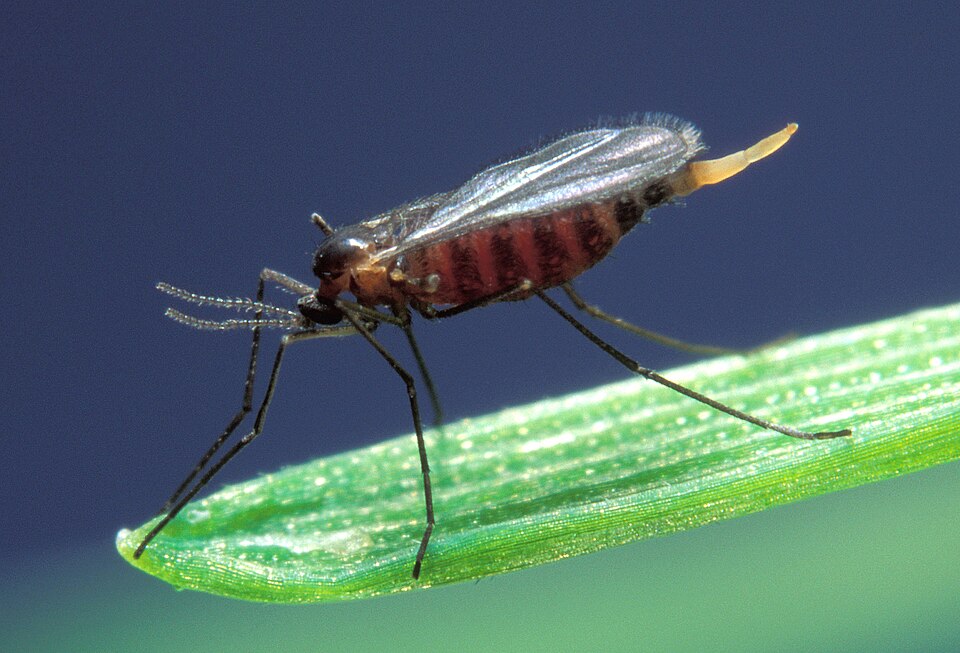
The Hessian fly is a tiny brown or black fly that lives only a few days as a grown-up. Its little white maggots live on wheat, barley and rye. Farmers know it well, because it can ruin a whole field of grain.
How fast is it?
Fun facts
Its eggs are tiny and bright orange.
Before it becomes a fly, it rests in a hard brown case that looks like a flax seed.
One mother fly can lay up to 200 eggs on wheat leaves.
The grown-up fly lives for only 1 to 4 days.
In 1836 so many of these flies ate the wheat in America that farmers ran short of grain.
Most asked questions about Hessian fly
?Why is it called the Hessian fly?
People thought Hessian soldiers from Germany brought it to America in their straw bedding long ago.
?Is the Hessian fly harmful?
It cannot hurt people, but its maggots can badly damage wheat, barley and rye.
Myth buster
Myth: The Hessian fly comes from Germany.
Truth: No. It got its name because people thought German soldiers brought it to America, but it first came from the Middle East.
For bug experts
- Scientific name
- Mayetiola destructor
- Named by
- Say, 1817
- Group
- Flies and mosquitoes
- Family
- Cecidomyiidae
- Classification
- Insecta > Diptera > Cecidomyiidae
- Lives on
- Asia, Europe, Africa, North America, Australia and Oceania
- Also known as
- Barley midge
Where the facts come from
- Hessian fly (Wikipedia, CC BY-SA 4.0): what it looks like, where it lives, what it eats, sizes and fun facts, retold in simple words.
- Picture by This image was released by the Agricultural Research Service , the research agency of the United States Department of Agriculture , with the ID k4193-19 (next) . Public domain, Wikimedia Commons. The round sticker of this bug is cut from the same picture.
If we got something wrong, sorry, we are bug fans, not a science journal. Tell us at hello@bugwiki.app and we will fix it.
 Housefly
 New World screwworm fly
 Lovebug
 Tsetse fly
 Common fruit fly
 Asian tiger mosquito
 Southern yellowjacket
 Common blue
 Red velvet mite
 Common buckeye
 St Andrew's cross spider
 Lime butterfly