

Bug card No. 0812 of 1,500
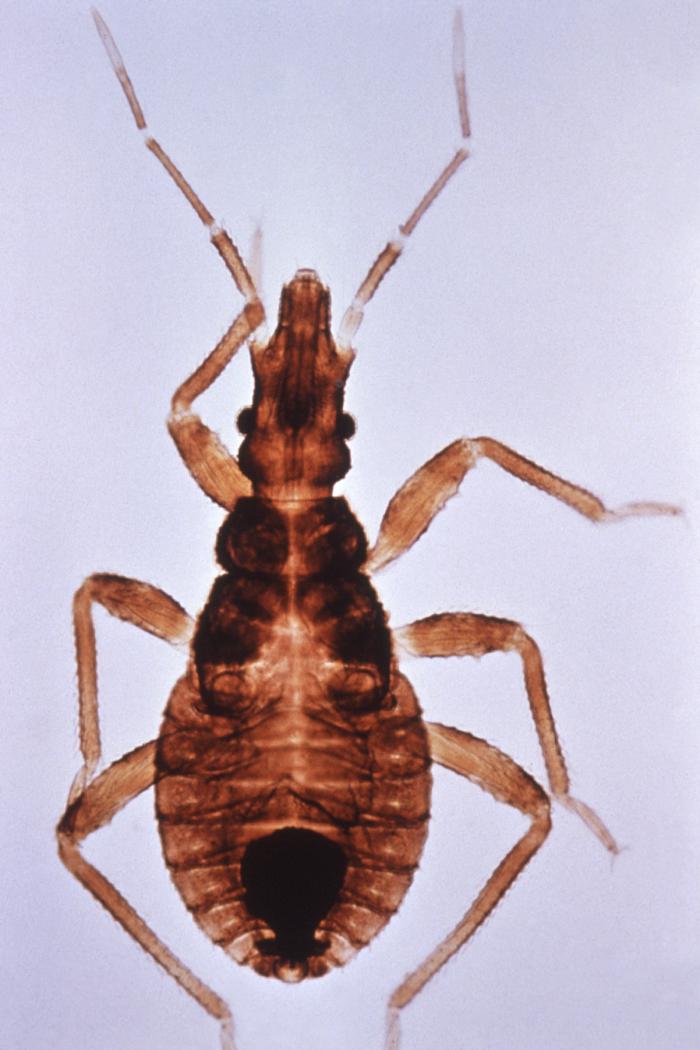
Kissing bug
Triatoma infestans
The kissing bug is a dark bug from South America that drinks blood. It mostly lives inside people's homes and comes out at night. It can carry a tiny germ that causes an illness called Chagas disease.
Lives in
South America, especially Bolivia, Paraguay, Argentina, Chile and Brazil
What does it eat?
It drinks the blood of people and animals. Before a meal it is thin, and afterwards it is round and fat with blood.
How fast is it?
A garden snail about 0.05 km/h (0.03 mph)
Kissing bug about 0.2 km/h (0.12 mph)
A tortoise about 0.3 km/h (0.19 mph)
A person walking about 5 km/h (3.1 mph)
cool stuff
Fun facts
1
The famous scientist Charles Darwin met these bugs in Argentina in 1835 and wrote about it in his diary.
2
Darwin wrote that the bugs were thin before feeding and round and bloated afterwards.
3
Countries in South America work together to get rid of these bugs from homes.
you asked
Most asked questions about Kissing bug
?Why is it called a kissing bug?
These bugs often come to drink blood at night from a sleeping person's face, which is how they got their name.
?Where does the kissing bug live?
In South America, mostly inside homes.
For bug experts
- Scientific name
- Triatoma infestans
- Group
- True bugs and cicadas
- Family
- Reduviidae
- Classification
- Insecta > Hemiptera > Reduviidae
- Lives on
- South America
- Also known as
- Barber bug, Vinchuca, Barbeiro
Where the facts come from
- Triatoma infestans (Wikipedia, CC BY-SA 4.0): what it looks like, where it lives, what it eats, sizes and fun facts, retold in simple words.
- Picture by unknown author. Public domain, Wikimedia Commons. The round sticker of this bug is cut from the same picture.
If we got something wrong, sorry, we are bug fans, not a science journal. Tell us at hello@bugwiki.app and we will fix it.
 Pharaoh cicada
 Spotted lanternfly
 Brown marmorated stink bug
 Cochineal
 Boxelder bug
 Western conifer seed bug
 Longhorn crazy ant
 Cardinal spider
 African malaria mosquito
 Greenhouse camel cricket
 Italian scorpion
 Thief ant