

Milkweed tussock moth
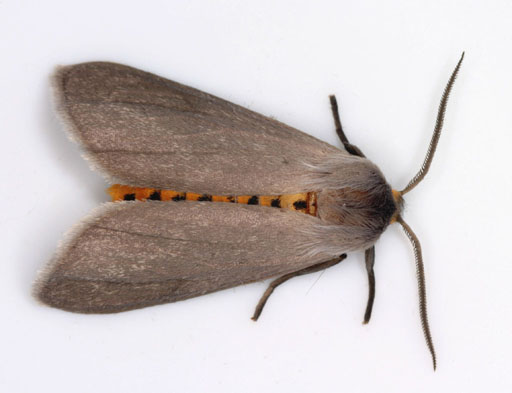
The milkweed tussock moth is a grey moth with a hairy yellow tummy and a row of black dots on it. Its caterpillar is even more eye-catching, with fluffy tufts of black, white and orange hairs. It eats milkweed, a plant full of bitter juice, and that bitter taste stays inside it and keeps hungry bats away.
How fast is it?
Fun facts
The moth can make tiny clicking sounds to tell bats: I taste bad, leave me alone.
Milkweed has sticky milky juice that can glue up a caterpillar's mouth. Bigger caterpillars cleverly bite the leaf veins first so the juice stops flowing.
Young caterpillars eat together in a big group, but older ones wander off alone or in small gangs.
It makes a grey, felt-like cocoon out of its own caterpillar hairs and stays in it all winter.
It shares milkweed with monarch caterpillars, but they rarely meet: the monarchs like young shoots and these caterpillars like older ones.
Most asked questions about Milkweed tussock moth
?What does the milkweed tussock moth caterpillar eat?
Mostly milkweed leaves, and sometimes dogbane. It eats them in groups when it is young.
?Is the milkweed tussock moth caterpillar dangerous?
No, it is harmless to people. Its bitter taste only protects it from animals that want to eat it.
?How big does the caterpillar get?
It grows to about 3.5 centimetres long before it makes its cocoon.
For bug experts
- Scientific name
- Euchaetes egle
- Named by
- Drury, 1773
- Group
- Moths
- Family
- Erebidae
- Classification
- Insecta > Lepidoptera > Erebidae
- Lives on
- North America
- Also known as
- Milkweed tiger moth
Where the facts come from
- Euchaetes egle (Wikipedia, CC BY-SA 4.0): what it looks like, where it lives, what it eats, sizes and fun facts, retold in simple words.
- Picture by Patrick Coin ( Patrick Coin ). CC BY-SA 2.5, Wikimedia Commons. The round sticker of this bug is cut from the same picture.
If we got something wrong, sorry, we are bug fans, not a science journal. Tell us at hello@bugwiki.app and we will fix it.
 Atlas moth
 Luna moth
 Hummingbird hawk-moth
 Domestic silk moth
 Isabella tiger moth
 Polyphemus moth
 European crane fly
 Brown-belted bumblebee
 Rainbow leaf beetle
 Common grass yellow
 Swollen-thighed beetle
 Common striped woodlouse