

Bug card No. 0991 of 1,500
Orange baboon tarantula
Pterinochilus murinus
Eats: Other bugs and small animalsSpidersDeserts and dry places8 legsNot an insect, but a bug cousin
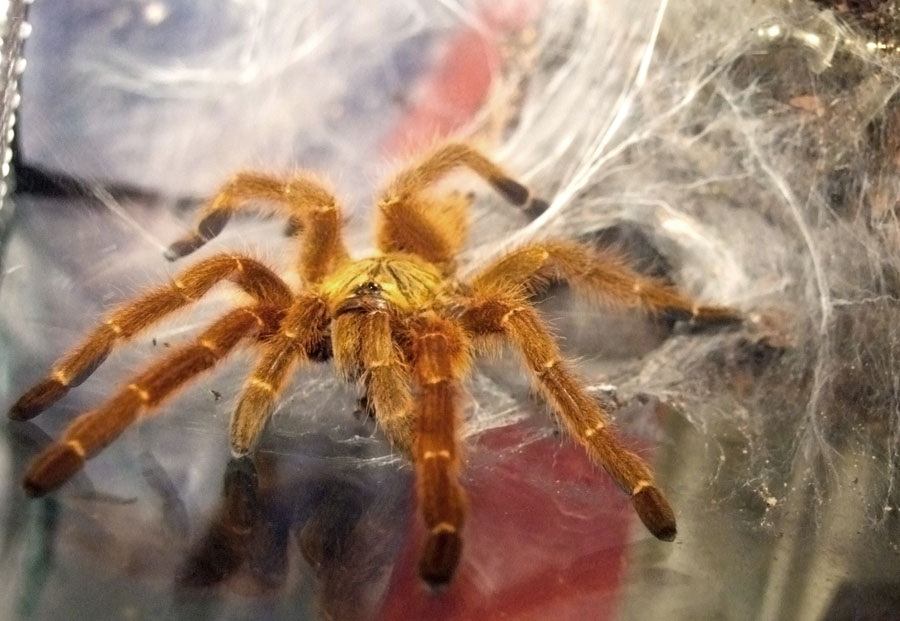
The orange baboon tarantula is a hairy spider from Africa that can be bright orange, red or brown. It has a star pattern on its front and colourful rings on its legs.
Fun fact: spiders are not insects. Insects have six legs, spiders have eight. Everyone calls them bugs anyway!
Lives in
Central and southern Africa, including Angola and Zanzibar
What does it eat?
It hunts insects like crickets and grasshoppers, and can even catch small lizards and mice.
How fast is it?
A tortoise about 0.3 km/h (0.19 mph)
Orange baboon tarantula about 1.5 km/h (0.93 mph)
A person walking about 5 km/h (3.1 mph)
A kid running fast about 13 km/h (8.1 mph)
cool stuff
Fun facts
1
Pet keepers call it OBT, which they joke stands for orange bitey thing.
2
Its colour may depend on the kind of soil where it lives.
3
The female digs a burrow, or moves into an empty one someone else dug.
you asked
Most asked questions about Orange baboon tarantula
?Why is it called a baboon spider?
African tarantulas like this one are known as baboon spiders. Its orange colour gives it the rest of its name.
?How big is an orange baboon tarantula?
With its legs, a female can be 10 to 15 centimetres across. Males are a bit smaller.
For bug experts
- Scientific name
- Pterinochilus murinus
- Named by
- Pocock, 1897
- Group
- Spiders
- Family
- Theraphosidae
- Classification
- Arachnida > Araneae > Theraphosidae
- Lives on
- Africa
- Also known as
- OBT, Mombasa golden starburst tarantula
Where the facts come from
- Pterinochilus murinus (Wikipedia, CC BY-SA 4.0): what it looks like, where it lives, what it eats, sizes and fun facts, retold in simple words.
- Picture by Galak76 10:22, 15 January 2007 (UTC). CC BY-SA 3.0, Wikimedia Commons. The round sticker of this bug is cut from the same picture.
If we got something wrong, sorry, we are bug fans, not a science journal. Tell us at hello@bugwiki.app and we will fix it.
 European garden spider
 Goliath birdeater
 Brown recluse
 Redback spider
 Yellow garden spider
 Bold jumping spider
 Mormon cricket
 Maricopa harvester ant
 Tiger centipede
 Dawson's burrowing bee
 Northern scorpion
 Master blister beetle