

Pine hawk-moth
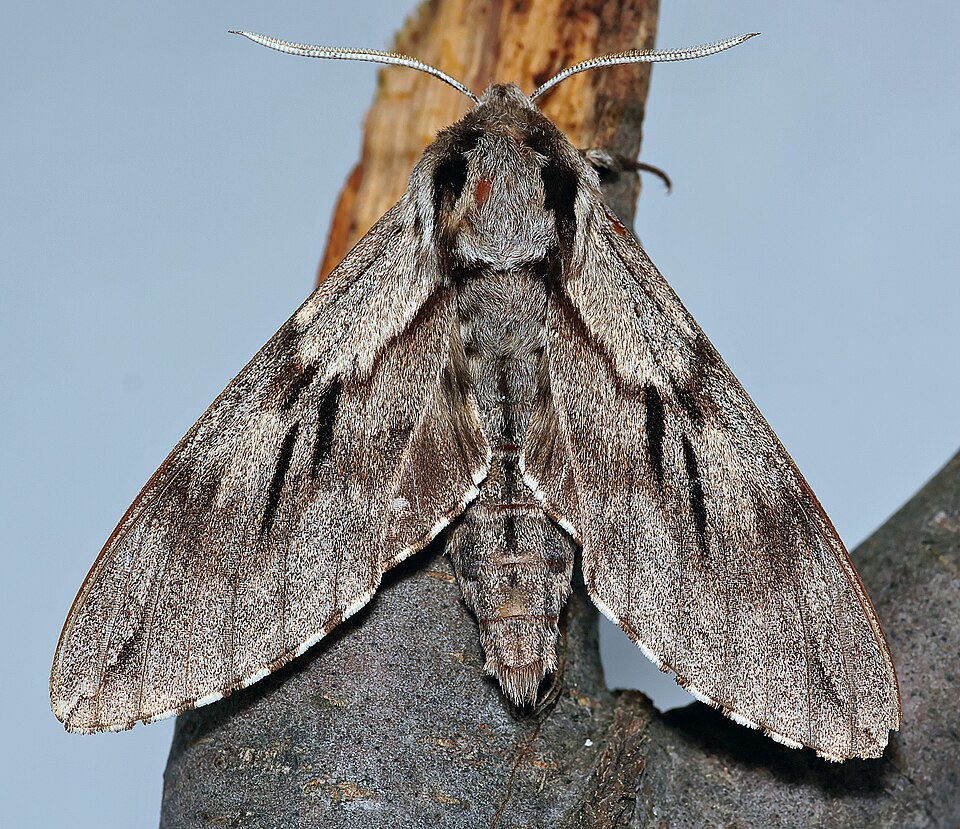
The pine hawk-moth is a big grey moth with little black dashes on its wings. When it sits on the bark of a pine tree, it is very hard to see. It is a hawk-moth, a strong and fast flyer.
How big is it?
How wide are its wings?
How big is Pine hawk-moth compared to YOU?
Just maths in your browser. Nothing is saved or sent anywhere.
How fast is it?
Fun facts
Its wings are 7 to 9 centimetres across, wider than a grown-up's palm.
The mother lays her eggs in little groups of two or three along pine or spruce needles.
It flies from April to August, depending on where it lives.
Its back has two dark bands, one on each side.
Most asked questions about Pine hawk-moth
?What does the pine hawk-moth caterpillar eat?
It eats the needles of pine and spruce trees.
?How big is the pine hawk-moth?
Its wings are about 70 to 89 millimetres across.
?Is the pine hawk-moth dangerous?
No. It is a harmless moth.
For bug experts
- Scientific name
- Sphinx pinastri
- Named by
- Linnaeus, 1758
- Group
- Moths
- Family
- Sphingidae
- Classification
- Insecta > Lepidoptera > Sphingidae
- Lives on
- Europe, Asia
Where the facts come from
- Sphinx pinastri (Wikipedia, CC BY-SA 4.0): what it looks like, where it lives, what it eats, sizes and fun facts, retold in simple words.
- Picture by Michael Apel. CC BY-SA 3.0, Wikimedia Commons. The round sticker of this bug is cut from the same picture.
If we got something wrong, sorry, we are bug fans, not a science journal. Tell us at hello@bugwiki.app and we will fix it.
 Atlas moth
 Luna moth
 Hummingbird hawk-moth
 Domestic silk moth
 Isabella tiger moth
 Polyphemus moth
 Red triangle slug
 Canadian tiger swallowtail
 Spined micrathena
 Goliath stick insect
 Black and gold flat millipede
 Golden stag beetle