

Teddy bear bee
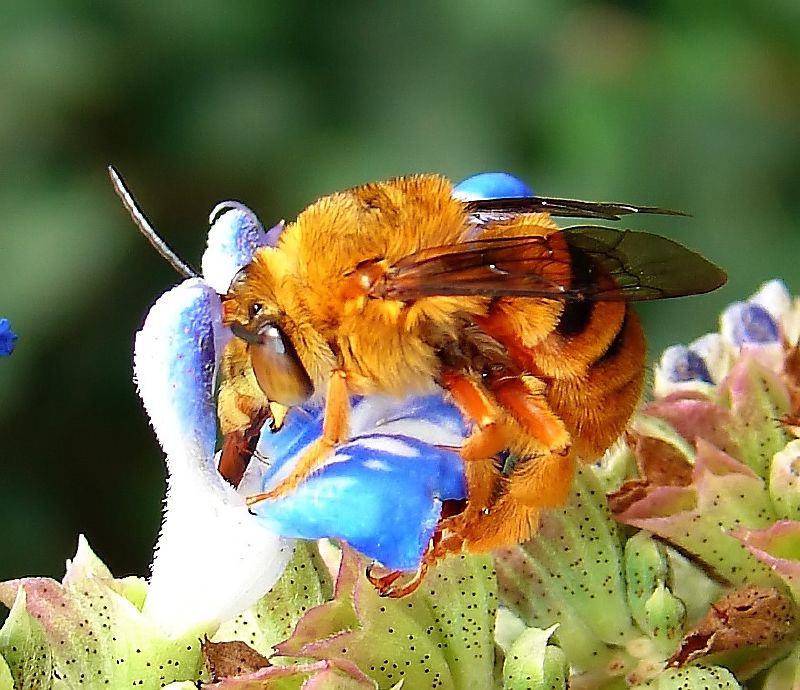
The teddy bear bee is a chubby bee covered in soft orange-brown fur, just like a tiny teddy bear. It is about as big as a honeybee and has dark stripes across its tummy. It lives in Australia and loves to visit garden flowers.
How fast is it?
Fun facts
At night the males hold onto plant stems with their jaws and sleep there.
The mother digs a tunnel about 10 centimetres long in the soil, with little urn-shaped rooms at the end for her eggs.
She lines each room with a waterproof layer so the baby stays dry.
Males have seven dark stripes on their tummy and females have six.
A sneaky cuckoo bee sometimes lays its own egg in its nest, and that baby eats the food meant for the teddy bear bee baby.
Most asked questions about Teddy bear bee
?Why is it called a teddy bear bee?
Because it is round and covered in fluffy orange-brown fur, like a little teddy bear.
?Where do teddy bear bees live?
In eastern Australia and New Guinea, often in gardens with lots of flowers.
For bug experts
- Scientific name
- Amegilla bombiformis
- Named by
- Smith, 1854
- Group
- Bees and bumblebees
- Family
- Apidae
- Classification
- Insecta > Hymenoptera > Apidae
- Lives on
- Australia and Oceania
Where the facts come from
- Amegilla bombiformis (Wikipedia, CC BY-SA 4.0): what it looks like, where it lives, what it eats, sizes and fun facts, retold in simple words.
- Picture by Louise Docker. CC BY 2.0, Wikimedia Commons. The round sticker of this bug is cut from the same picture.
If we got something wrong, sorry, we are bug fans, not a science journal. Tell us at hello@bugwiki.app and we will fix it.
 Western honey bee
 Buff-tailed bumblebee
 Violet carpenter bee
 Giant honey bee
 Wallace's giant bee
 Himalayan giant honey bee
 Fall webworm
 Large bee-fly
 Viceroy butterfly
 Green shield bug
 Oleander hawk-moth
 White-marked tussock moth