

Tree bumblebee
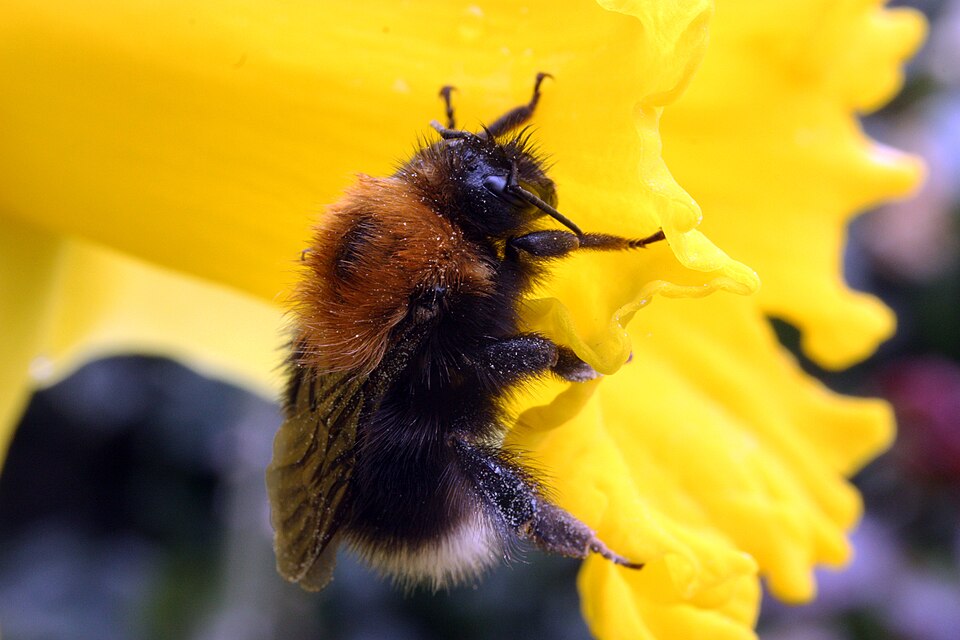
The tree bumblebee is a fluffy bumblebee with three colours. Its front part is ginger brown, the middle is black and the tip of its tail is always white. It likes to live close to people and often makes its nest in a bird box.
How fast is it?
Fun facts
Unlike most bumblebees, it builds its nest up high, in tree holes, walls and bird boxes.
It was first seen in Britain in 2001. Since then it has spread all the way to Scotland and reached Ireland in 2017.
A nest can have 150 worker bees or more, maybe even 400.
Whether a baby bee grows into a queen or a worker depends on how much food it gets.
In Iceland it was first found in 2008, and it lives there near towns where people live.
Most asked questions about Tree bumblebee
?How do you recognise a tree bumblebee?
Look for a ginger front, a black middle and a white tail tip.
For bug experts
- Scientific name
- Bombus hypnorum
- Group
- Bees and bumblebees
- Family
- Apidae
- Classification
- Insecta > Hymenoptera > Apidae
- Lives on
- Europe, Asia
- Also known as
- New garden bumblebee
Where the facts come from
- Bombus hypnorum (Wikipedia, CC BY-SA 4.0): what it looks like, where it lives, what it eats, sizes and fun facts, retold in simple words.
- Picture by Charles J. Sharp. CC BY-SA 3.0, Wikimedia Commons. The round sticker of this bug is cut from the same picture.
If we got something wrong, sorry, we are bug fans, not a science journal. Tell us at hello@bugwiki.app and we will fix it.
 Western honey bee
 Buff-tailed bumblebee
 Violet carpenter bee
 Giant honey bee
 Wallace's giant bee
 Himalayan giant honey bee
 Tersa sphinx
 Ailanthus silkmoth
 Samurai wasp
 Bull ant
 Peach-potato aphid
 Giant Palouse earthworm
.jpg)