

Bug card No. 0165 of 1,500
Blue-winged wasp
Scolia dubia
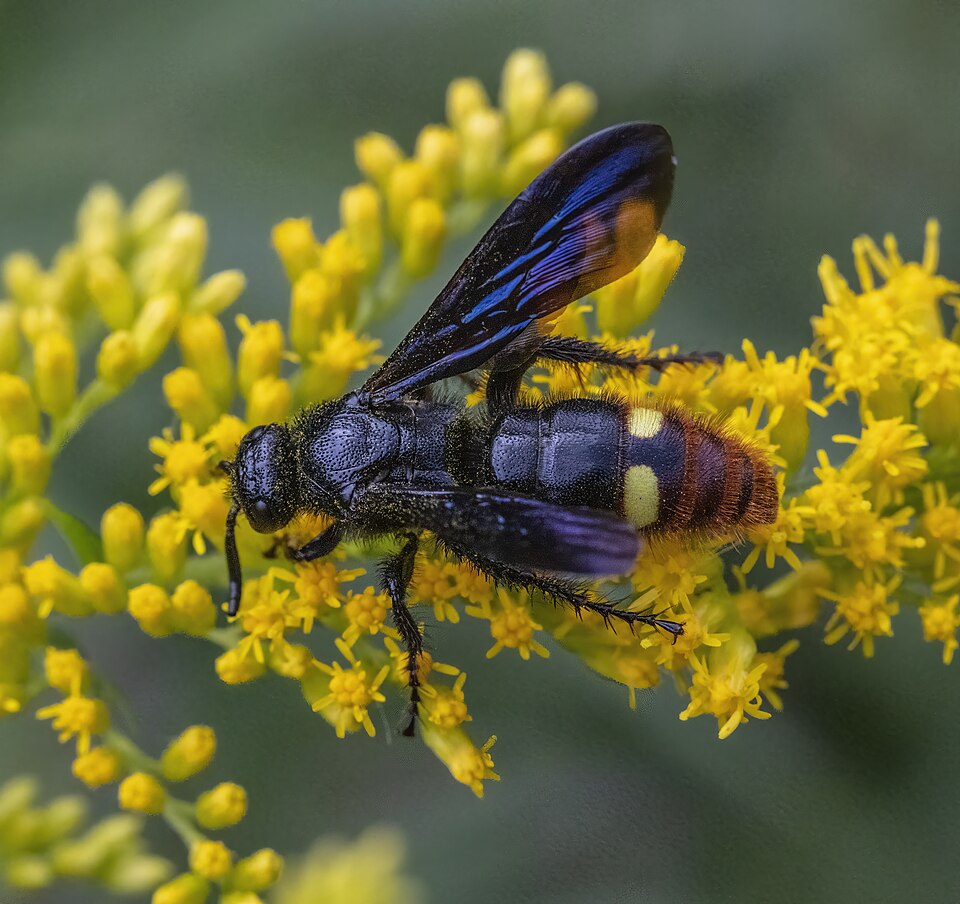
The blue-winged wasp is a black wasp with a red tail end and two yellow spots. Its dark wings shimmer blue in the sun. It is a garden helper that hunts beetle grubs under the ground.
Lives in
The United States from New England to Florida and west to California, and northern Mexico, in gardens and meadows
Length
2 to 2.5 cm (0.79 to 0.98 in)
What does it eat?
The grown-ups sip nectar from flowers in late summer. Their babies feed on beetle grubs that the mother finds in the soil.
How big is it?
How long is it?
🍚as long as 4 grains of rice in a row⚽could fly across a whole football pitch in 14 seconds⚡moves 310 times its own body length every second
How big is Blue-winged wasp compared to YOU?
Just maths in your browser. Nothing is saved or sent anywhere.
How fast is it?
A kid running fast about 13 km/h (8.1 mph)
A grown-up on a bike about 25 km/h (16 mph)
Blue-winged wasp about 28 km/h (17 mph)
A car driving in town about 50 km/h (31 mph)
cool stuff
Fun facts
1
The baby wasp eats the grub and then spends the winter right there, inside the grub's body.
2
It may also help fight Japanese beetles, which are garden pests.
3
Grown-ups visit flowers for nectar from July to October.
4
In late summer, big groups of males fly together looking for mates.
you asked
Most asked questions about Blue-winged wasp
?Are blue-winged wasps good for the garden?
Yes. They hunt the grubs of June beetles and maybe Japanese beetles, and they visit flowers.
For bug experts
- Scientific name
- Scolia dubia
- Named by
- Say, 1837
- Group
- Wasps and hornets
- Family
- Scoliidae
- Classification
- Insecta > Hymenoptera > Scoliidae
- Lives on
- North America
- Also known as
- Two-spotted scoliid wasp, Blue-winged scoliid wasp
Where the facts come from
- Scolia dubia (Wikipedia, CC BY-SA 4.0): what it looks like, where it lives, what it eats, sizes and fun facts, retold in simple words.
- Picture by Acroterion. CC BY-SA 4.0, Wikimedia Commons. The round sticker of this bug is cut from the same picture.
If we got something wrong, sorry, we are bug fans, not a science journal. Tell us at hello@bugwiki.app and we will fix it.
 European hornet
 Northern giant hornet
 Bald-faced hornet
 Red velvet ant
 Eastern cicada killer
 Asian hornet
 Baltimore checkerspot
 Allegheny mound ant
 Common crab spider
 Wasp nest beetle
 Milk snail
 Nsenene