

Hide beetle
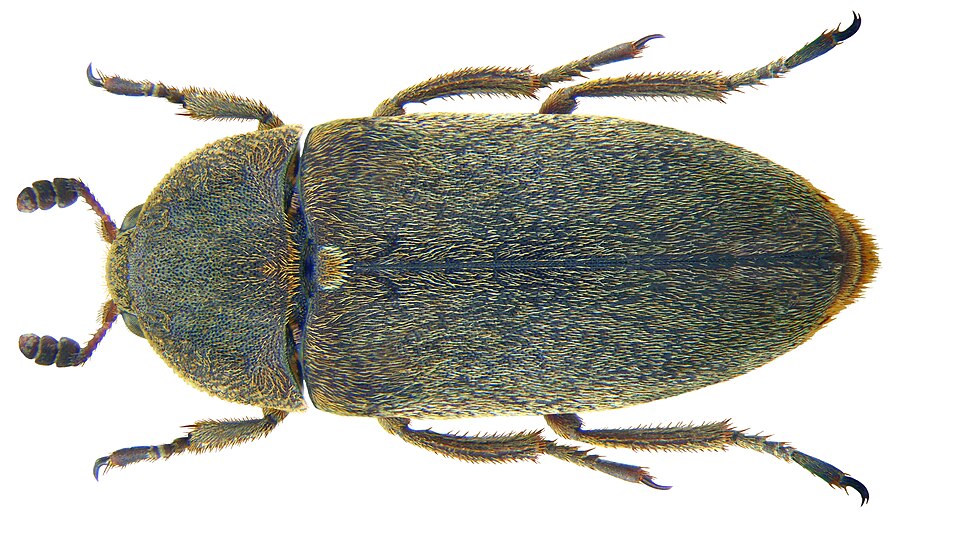
The hide beetle is a small black beetle with a stripe of white hairs on each side and a white tummy with black spots. It is nature's clean up crew: it eats dried up animal leftovers. Its hairy larvae can nibble a dead animal until only clean bones are left.
How big is it?
How long is it?
How big is Hide beetle compared to YOU?
Just maths in your browser. Nothing is saved or sent anywhere.
How fast is it?
Fun facts
Museums and universities keep hide beetles to clean animal bones for skeletons. People have done this for over 150 years.
It is extra good at cleaning tiny, delicate bones of small animals.
Long ago in London, these beetles damaged so many animal skins in warehouses that a reward of 20,000 pounds was offered for a way to stop them.
Its larva has two little horns at the end of its body that curve upwards.
A grown up hide beetle can live four to six months.
Most asked questions about Hide beetle
?Is the hide beetle dangerous?
No, but the hairs of its larvae can make some people's skin itchy, so do not touch them.
?What does the hide beetle eat?
Dead animals and dried animal foods like dried fish, cheese, bacon and pet treats.
?Why do museums use hide beetles?
Their larvae nibble away everything except the bones, which leaves a clean skeleton to study.
For bug experts
- Scientific name
- Dermestes maculatus
- Group
- Beetles
- Family
- Dermestidae
- Classification
- Insecta > Coleoptera > Dermestidae
- Lives on
- Europe, Asia, Africa, North America, South America, Australia and Oceania
Where the facts come from
- Dermestes maculatus (Wikipedia, CC BY-SA 4.0): what it looks like, where it lives, what it eats, sizes and fun facts, retold in simple words.
- Picture by Udo Schmidt. CC BY-SA 2.0, Wikimedia Commons. The round sticker of this bug is cut from the same picture.
If we got something wrong, sorry, we are bug fans, not a science journal. Tell us at hello@bugwiki.app and we will fix it.
 Stag beetle
 Hercules beetle
 Common glow-worm
 Goliath beetle
 Cockchafer
 Mealworm beetle
 Pharaoh ant
 White-tailed spider
 Domestic house spider
 Black house spider
 Eastern parson spider
 Black and yellow mud dauber