

Ladybird spider
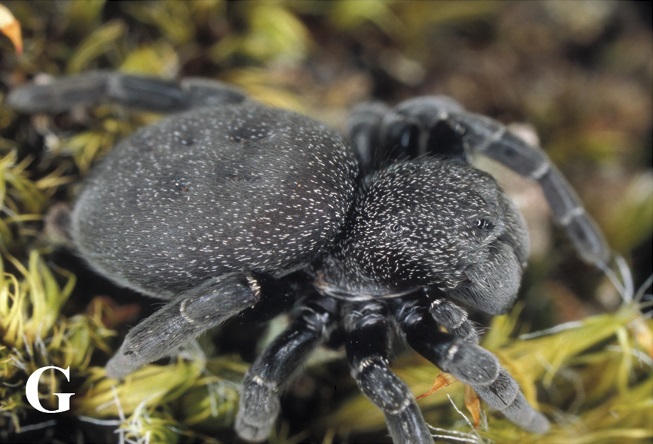
The ladybird spider gets its name from the boy spider, who is bright orange with big black spots, just like a ladybird. The girl spider looks completely different: she is bigger and shiny jet black. It is rare and protected in many countries.
How big is it?
How long is it?
How big is Ladybird spider compared to YOU?
Just maths in your browser. Nothing is saved or sent anywhere.
How fast is it?
Fun facts
A boy becomes grown up in September, but he waits all winter in his web and only goes looking for a girl in May or June.
A mother lays 35 to 80 eggs and feeds her babies with a liquid from her mouth.
The mother gives everything for her babies and stays with them until the end of her life.
In 1993 only about 50 ladybird spiders were left in Britain, but thanks to people helping them there were over 600 by 2000.
The young spiders leave their mum's web the next spring and build their own webs close by.
Most asked questions about Ladybird spider
?Why is it called a ladybird spider?
Because the boy is bright orange with black spots, like a ladybird.
?Is the ladybird spider rare?
Yes. It is endangered in Britain and rare in several other European countries.
For bug experts
- Scientific name
- Eresus sandaliatus
- Group
- Spiders
- Family
- Eresidae
- Classification
- Arachnida > Araneae > Eresidae
- Lives on
- Europe
Where the facts come from
- Eresus sandaliatus (Wikipedia, CC BY-SA 4.0): what it looks like, where it lives, what it eats, sizes and fun facts, retold in simple words.
- Picture by Jørgen Lissner. CC BY 3.0, Wikimedia Commons. The round sticker of this bug is cut from the same picture.
If we got something wrong, sorry, we are bug fans, not a science journal. Tell us at hello@bugwiki.app and we will fix it.
 European garden spider
 Goliath birdeater
 Brown recluse
 Redback spider
 Yellow garden spider
 Bold jumping spider
 Rusty millipede
 Ashy mining bee
 Harvest mite
 Oriental fruit fly
 Differential grasshopper
 Dogbane beetle