

Spanish moon moth
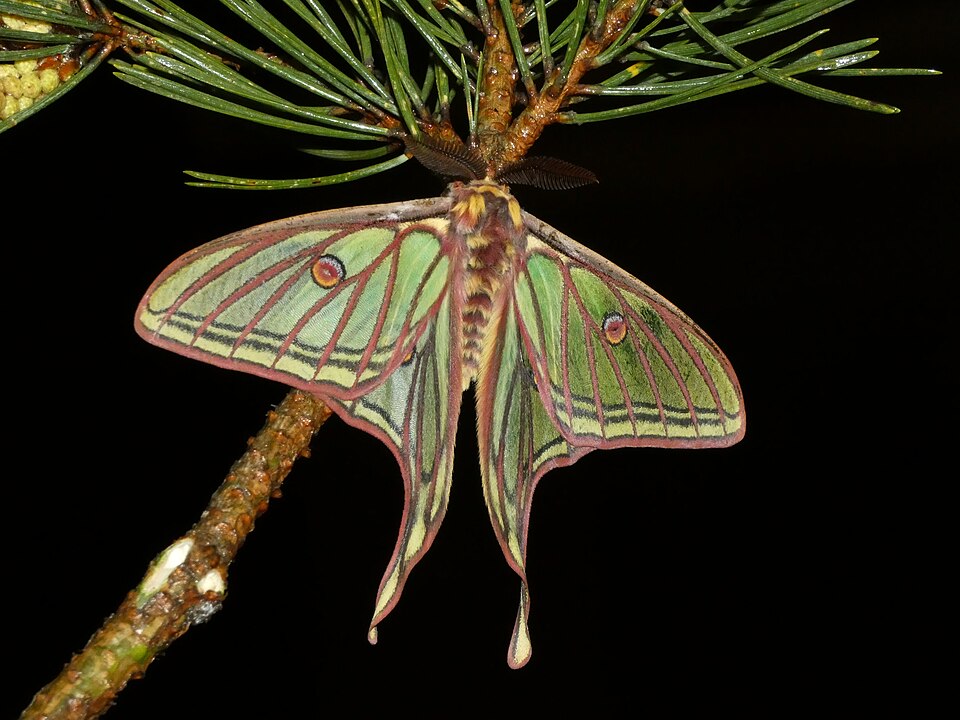
The Spanish moon moth is a beautiful pale green moth with long tails on its back wings. It lives high up in the cold pine forests of the mountains of Spain and France. It has survived there since the Ice Age, while the world around it changed.
How fast is it?
Fun facts
Its small mountain homes stayed the same for a very long time while Europe's weather changed, so it is a living leftover from the Ice Age.
A mother lays about 100 to 150 eggs on pine trees.
When the caterpillars are fully grown, they climb down from the tree and make their cocoons under leaves on the ground.
It spends the whole winter inside its cocoon and comes out as a moth at the end of April or in May.
Its closest relatives are the moon moths of Asia and America.
Most asked questions about Spanish moon moth
?Where does the Spanish moon moth live?
High in the pine forests of the mountains of Spain and France.
?What does the Spanish moon moth caterpillar eat?
It eats pine needles, mostly from black pine and Scots pine.
?Is the Spanish moon moth rare?
It lives only in small mountain areas, and it is protected in Europe.
For bug experts
- Scientific name
- Graellsia isabellae
- Named by
- Graells, 1849
- Group
- Moths
- Family
- Saturniidae
- Classification
- Insecta > Lepidoptera > Saturniidae
- Lives on
- Europe
Where the facts come from
- Graellsia isabellae (Wikipedia, CC BY-SA 4.0): what it looks like, where it lives, what it eats, sizes and fun facts, retold in simple words.
- Picture by (c) Juan Rodríguez, some rights reserved (CC BY). CC BY 4.0, Wikimedia Commons. The round sticker of this bug is cut from the same picture.
If we got something wrong, sorry, we are bug fans, not a science journal. Tell us at hello@bugwiki.app and we will fix it.
 Atlas moth
 Luna moth
 Hummingbird hawk-moth
 Domestic silk moth
 Isabella tiger moth
 Polyphemus moth
 Large pine weevil
 Red-brown longhorn beetle
 Jet ant
 Red poplar leaf beetle
 Snow fly
 Wood white