

Bug card No. 1330 of 1,500
Tarantula hawk
Pepsis grossa
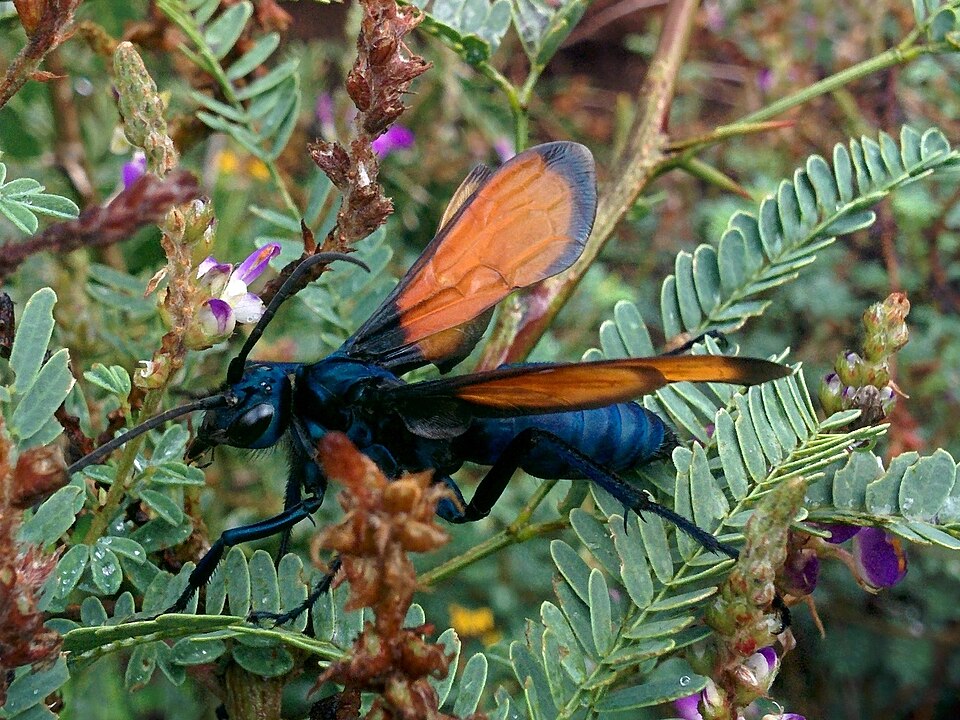
The tarantula hawk is a huge wasp with a shiny dark body and bright orange or black wings. It is brave enough to hunt tarantulas, the big hairy spiders. Its bright colours tell other animals: stay away from me.
Lives in
From the southern United States through Mexico and Central America to northern South America, in dry, sunny places
Length
2.4 to 5.1 cm (0.94 to 2 in)
What does it eat?
The grown-up wasps drink nectar from flowers like milkweed. The mother catches a tarantula as food for her baby.
How big is it?
How long is it?
🍚as long as 8 grains of rice in a row🧱as long as 1.5 toy building bricks in a row⚽could fly across a whole football pitch in 9.7 seconds⚡moves 210 times its own body length every second
How big is Tarantula hawk compared to YOU?
Just maths in your browser. Nothing is saved or sent anywhere.
How fast is it?
A kid running fast about 13 km/h (8.1 mph)
A grown-up on a bike about 25 km/h (16 mph)
Tarantula hawk about 39 km/h (24 mph)
A car driving in town about 50 km/h (31 mph)
cool stuff
Fun facts
1
It is the state insect of New Mexico.
2
Roadrunners sometimes steal the spider from the wasp and leave the wasp alone.
3
It helps flowers by carrying pollen, especially on milkweed plants.
you asked
Most asked questions about Tarantula hawk
?How big is a tarantula hawk?
The females are about 3 to 5 centimetres long. The males are a bit smaller.
?Why is it called a tarantula hawk?
Because it hunts tarantula spiders, like a hawk hunts mice.
For bug experts
- Scientific name
- Pepsis grossa
- Group
- Wasps and hornets
- Family
- Pompilidae
- Classification
- Insecta > Hymenoptera > Pompilidae
- Lives on
- North America, South America
Where the facts come from
- Pepsis grossa (Wikipedia, CC BY-SA 4.0): what it looks like, where it lives, what it eats, sizes and fun facts, retold in simple words.
- Picture by Niklas299. CC BY-SA 4.0, Wikimedia Commons. The round sticker of this bug is cut from the same picture.
If we got something wrong, sorry, we are bug fans, not a science journal. Tell us at hello@bugwiki.app and we will fix it.
 European hornet
 Northern giant hornet
 Bald-faced hornet
 Red velvet ant
 Eastern cicada killer
 Asian hornet
 Arizona bark scorpion
 Antarctic midge
 Himalayan giant honey bee
 Tarantula wolf spider
 Mormon cricket
 Saharan silver ant
.jpg)