

Trap-jaw ant
The trap-jaw ant is a dark brown ant with long jaws that it can open wide like a book. The jaws are spring-loaded, like a trap. When a tiny hair between them is touched, they snap shut super fast.
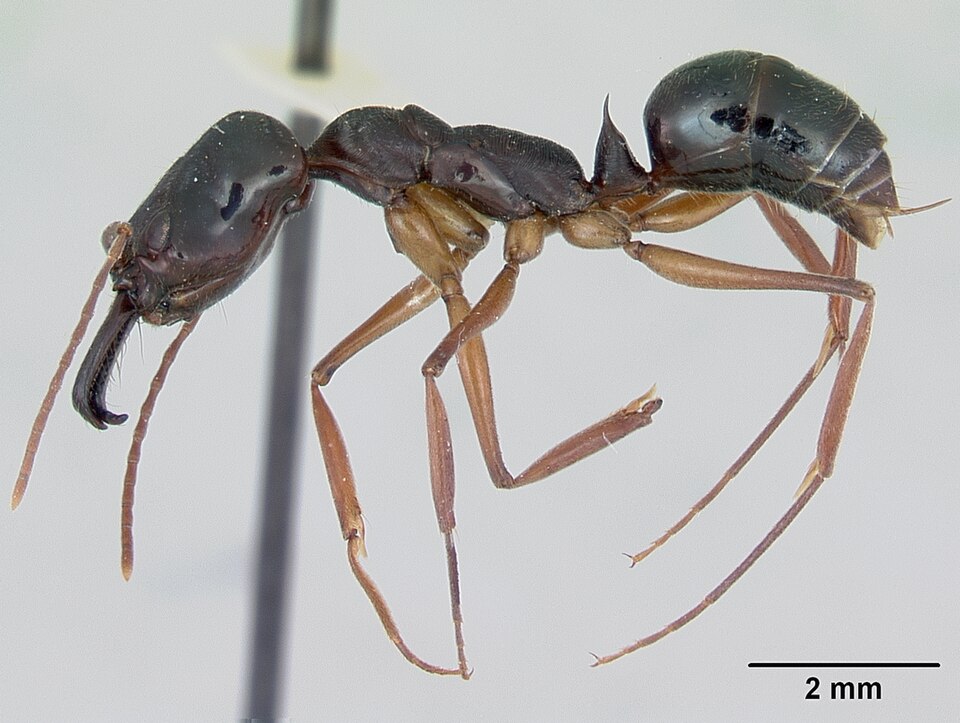
How fast is it?
Fun facts
Its jaws snap shut at up to 230 km/h, one of the fastest moves of any animal.
The jaws close about 2300 times faster than you can blink.
It can snap its jaws against the ground to fling itself away, more than 20 times its own body length.
One colony lives in several small nests close together, and these neighbours share food and do not fight.
Its jaws are so strong it can even catch termites that spray an irritating goo to defend themselves.
Most asked questions about Trap-jaw ant
?How fast are trap-jaw ant jaws?
They snap shut at up to 230 km/h, about 2300 times faster than a blink.
?What does the trap-jaw ant eat?
Small animals such as termites, woodlice, spiders and other insects.
For bug experts
- Scientific name
- Odontomachus bauri
- Group
- Ants
- Family
- Formicidae
- Classification
- Insecta > Hymenoptera > Formicidae
- Lives on
- North America, South America
Where the facts come from
- Odontomachus bauri (Wikipedia, CC BY-SA 4.0): what it looks like, where it lives, what it eats, sizes and fun facts, retold in simple words.
- Picture by April Nobile. CC BY 4.0, Wikimedia Commons. The round sticker of this bug is cut from the same picture.
If we got something wrong, sorry, we are bug fans, not a science journal. Tell us at hello@bugwiki.app and we will fix it.
 Black garden ant
 Bullet ant
 Pharaoh ant
 Argentine ant
 Red imported fire ant
 Yellow crazy ant
 Clipper butterfly
 Wallace's golden birdwing
 Florida whip spider
 Green-banded urania
 Sun beetle
 Royal Goliath beetle