

Blue-eyed ensign wasp
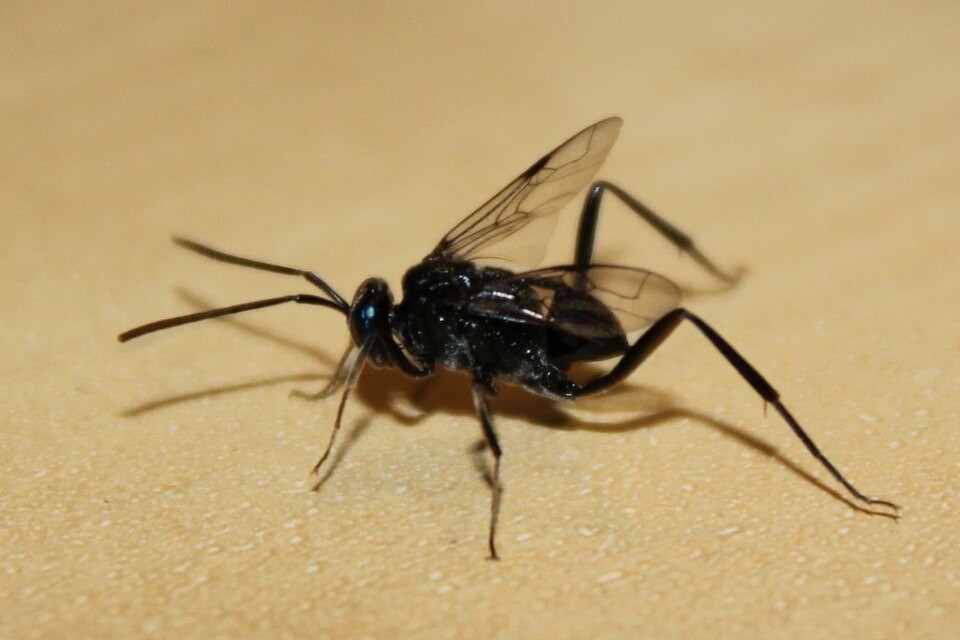
The blue-eyed ensign wasp is a small black wasp with bright blue eyes. Its tummy is tiny and sits high up on its body, held up like a little flag. It has a very special job: it lays its eggs inside cockroach egg cases.
How fast is it?
Fun facts
It is called an ensign wasp because its little tummy is held up like a flag, and ensign is an old word for a flag.
The mother lies on her side and drills into a tough cockroach egg case. It can take her half an hour of hard work.
She puts only one egg into each cockroach egg case.
The grown-up wasp lives for just two or three weeks.
Most asked questions about Blue-eyed ensign wasp
?Why is it called an ensign wasp?
Its small, flat tummy is held up high like a flag, and an ensign is a flag.
?Is the ensign wasp good to have around?
Many people think so, because its babies eat cockroach eggs, so there are fewer cockroaches.
For bug experts
- Scientific name
- Evania appendigaster
- Group
- Wasps and hornets
- Family
- Evaniidae
- Classification
- Insecta > Hymenoptera > Evaniidae
- Lives on
- Asia, Africa, North America, South America, Australia and Oceania
Where the facts come from
- Evania appendigaster (Wikipedia, CC BY-SA 4.0): what it looks like, where it lives, what it eats, sizes and fun facts, retold in simple words.
- Picture by David Crummey. CC BY 2.0, Wikimedia Commons. The round sticker of this bug is cut from the same picture.
If we got something wrong, sorry, we are bug fans, not a science journal. Tell us at hello@bugwiki.app and we will fix it.
 European hornet
 Northern giant hornet
 Bald-faced hornet
 Red velvet ant
 Eastern cicada killer
 Asian hornet
 Southern house mosquito
 Indian stick insect
 European yellow-tailed scorpion
 Rabbit hutch spider
 Lesser house fly
 Lace-webbed spider