

European paper wasp
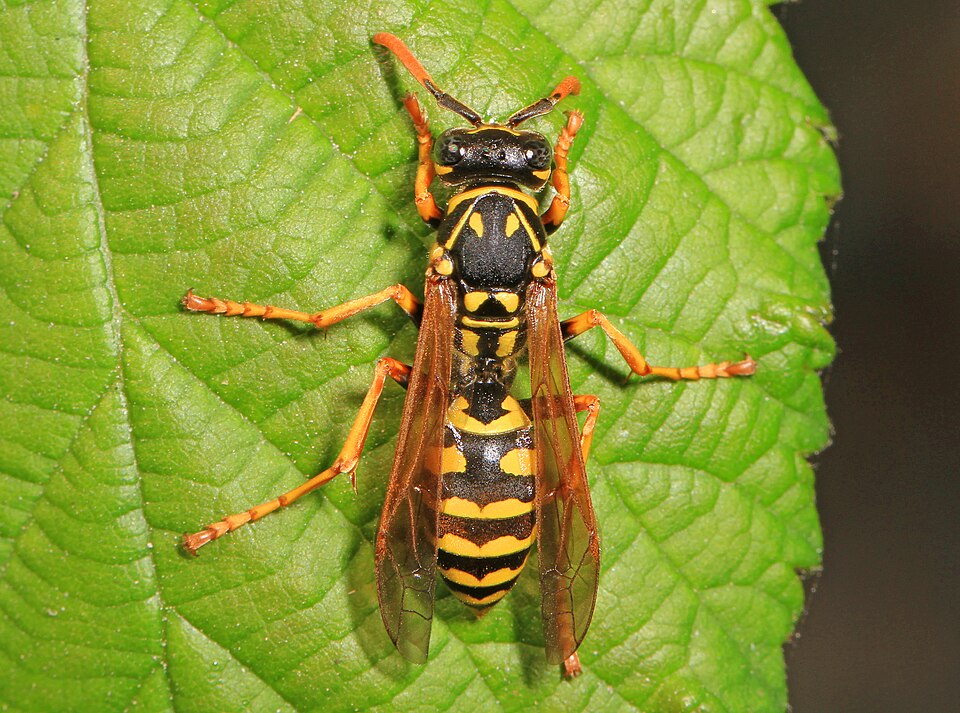
The European paper wasp is a yellow and black wasp that builds its nest out of paper. It makes the paper itself by chewing wood and mixing it with spit. Its nest of little six-sided rooms often hangs in sheltered spots on buildings.
How fast is it?
Fun facts
The queen is the boss and lays the eggs, while the other females go out to find food.
If the queen disappears, the next most important female becomes the new queen.
You can tell how important a female is by the markings on her face.
About a third of the wasps in one nest are not related to each other, which is unusual for wasps.
It probably travelled to new countries hidden in crates, trailers and boats.
Most asked questions about European paper wasp
?Why is it called a paper wasp?
Because it builds its nest from paper that it makes by chewing wood and mixing it with spit.
?Where do European paper wasps build their nests?
Often in sheltered places on buildings, like under roofs, but also in forests and grassland.
For bug experts
- Scientific name
- Polistes dominula
- Named by
- Christ, 1791
- Group
- Wasps and hornets
- Family
- Vespidae
- Classification
- Insecta > Hymenoptera > Vespidae
- Lives on
- Europe, Africa, Asia, North America, South America, Australia and Oceania
Where the facts come from
- European paper wasp (Wikipedia, CC BY-SA 4.0): what it looks like, where it lives, what it eats, sizes and fun facts, retold in simple words.
- Picture by Judy Gallagher. CC BY 2.0, Wikimedia Commons. The round sticker of this bug is cut from the same picture.
If we got something wrong, sorry, we are bug fans, not a science journal. Tell us at hello@bugwiki.app and we will fix it.
 European hornet
 Northern giant hornet
 Bald-faced hornet
 Red velvet ant
 Eastern cicada killer
 Asian hornet
 Florida carpenter ant
 Copper chafer
 Ring-legged earwig
 Portuguese millipede
 Six-spot burnet
 Egyptian grasshopper
.jpg)