

Human botfly
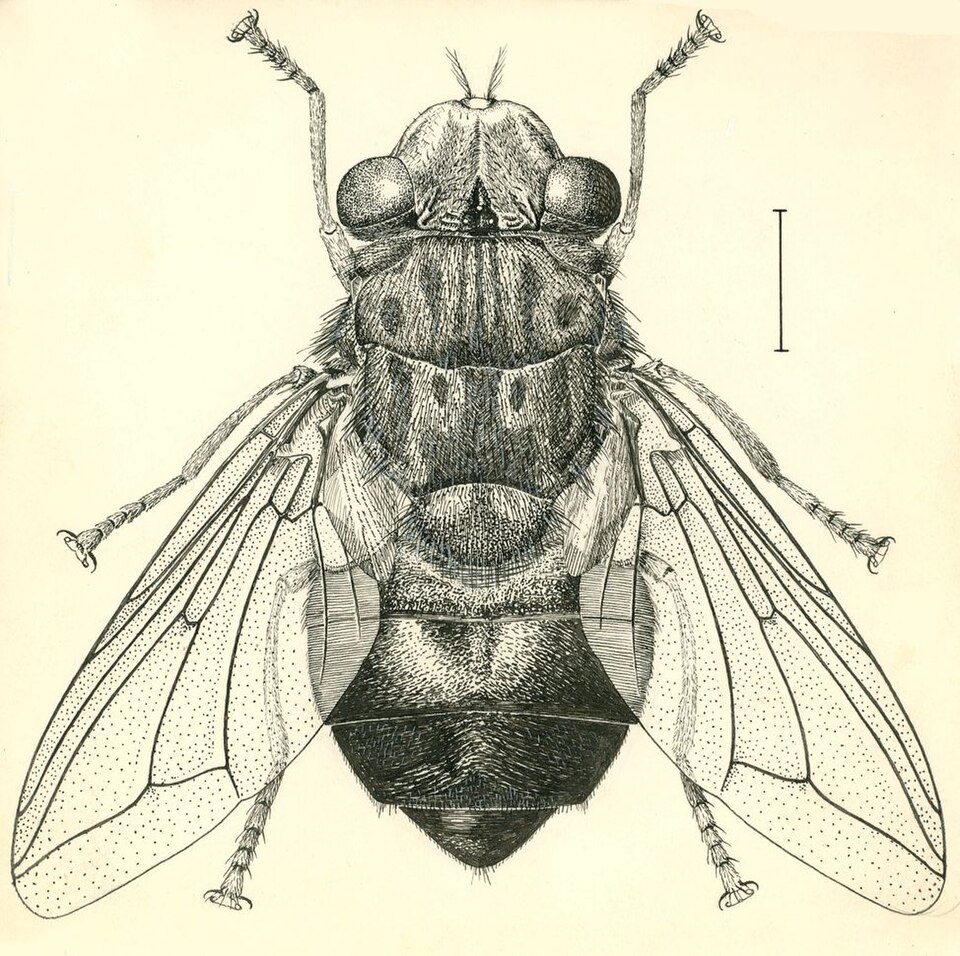
The human botfly is a big fly from the warm forests of Central and South America. It has a very sneaky way of getting its eggs to animals: it catches a mosquito and sticks its eggs onto it. The grown-up fly has no mouth at all, so it never eats.
How fast is it?
Fun facts
The mother botfly catches a mosquito, glues her eggs onto its body and lets it go. The mosquito then delivers the eggs.
More than 40 kinds of mosquitoes and other flies can carry its eggs.
After about eight weeks the larva drops to the ground and turns into a fly in the soil.
Doctors can get a larva out by covering the spot with petroleum jelly so it cannot breathe.
Most asked questions about Human botfly
?Is the human botfly dangerous?
Usually not seriously. Its larvae can live in skin for a few weeks, but a doctor can remove them.
?Where does the human botfly live?
In the warm parts of the Americas, from southeastern Mexico to northern Argentina.
?Does the human botfly bite?
No. The grown-up fly has no mouthparts, so it cannot bite or even eat.
For bug experts
- Scientific name
- Dermatobia hominis
- Group
- Flies and mosquitoes
- Family
- Oestridae
- Classification
- Insecta > Diptera > Oestridae
- Lives on
- North America, South America
- Also known as
- Torsalo, American warble fly
Where the facts come from
- Dermatobia hominis (Wikipedia, CC BY-SA 4.0): what it looks like, where it lives, what it eats, sizes and fun facts, retold in simple words.
- Picture by Arthur "Art" Cushman (retired USDA/SEL Illustrator). Public domain, Wikimedia Commons. The round sticker of this bug is cut from the same picture.
If we got something wrong, sorry, we are bug fans, not a science journal. Tell us at hello@bugwiki.app and we will fix it.
 Housefly
 New World screwworm fly
 Lovebug
 Tsetse fly
 Common fruit fly
 Asian tiger mosquito
 Chinese bird spider
 Mandaçaia bee
 Long-flange millipede
 Hercules beetle
 Emperor scorpion
 Bullet ant